Case: Navin Vishwanathan Prop. of M/s Oriental Facility vs State of Maharashtra
Writ Petition No.: 8709 of 2025
Citation: 2026:BHC-AS:17674-DB
Court: Bombay High Court
Date: 15 April 2026
In a significant ruling impacting GST recovery proceedings, the Bombay High Court has clarified a critical legal position:
Merely using the same trade name does not make a person liable for someone else’s GST dues.
The case highlights misuse of recovery provisions under GST law, where the department directly attached a son’s bank account to recover tax dues of his deceased father — without proper adjudication, notice, or legal basis.
This judgment is important for taxpayers, professionals, and GST officers alike, especially in cases involving legal heirs, business succession, and third-party recovery.
Case Background
- The father was running a proprietorship under the name “ABC Trading Company”
- After his death, the son started a business using the same trade name
- However:
- GSTIN was different
- PAN was different
- Business premises were different
Despite this, the GST Department:
- Initiated recovery for the father’s dues
- Issued Form GST DRC-13 to the son’s bank
- Attached (froze) the son’s bank account
Key Legal Issue
Can GST dues of a deceased person be recovered from another person merely because both used the same trade name?
Relevant Legal Provisions
Section 79 – Recovery of Tax (CGST Act)
- Empowers the department to recover dues through various modes
- Includes recovery from third persons (like bank attachment via DRC-13)
But important condition:
Recovery can start only after liability is legally determined
Section 93 – Liability of Legal Representative
- Applies when a taxpayer dies
- Legal heir is liable only if:
- They continue the business, or
- They are otherwise legally responsible
Not automatic liability
What the Department Did Wrong
Let’s be clear — the department’s approach in this case was legally weak.
1. No Adjudication of Liability
- No proper order establishing that the son was liable
- Liability was simply assumed
2. Misuse of Section 79
- Recovery started without first determining liability
- This defeats the purpose of due process
3. Ignored Section 93 Requirements
- No verification whether:
- Son continued the father’s business
- Or was legally liable as successor
4. Violation of Natural Justice
- No notice
- No hearing
- Direct bank attachment
This is not a procedural lapse — it is a serious legal defect.
Bombay High Court Judgment
The Court took a firm and correct view.
Key Observations:
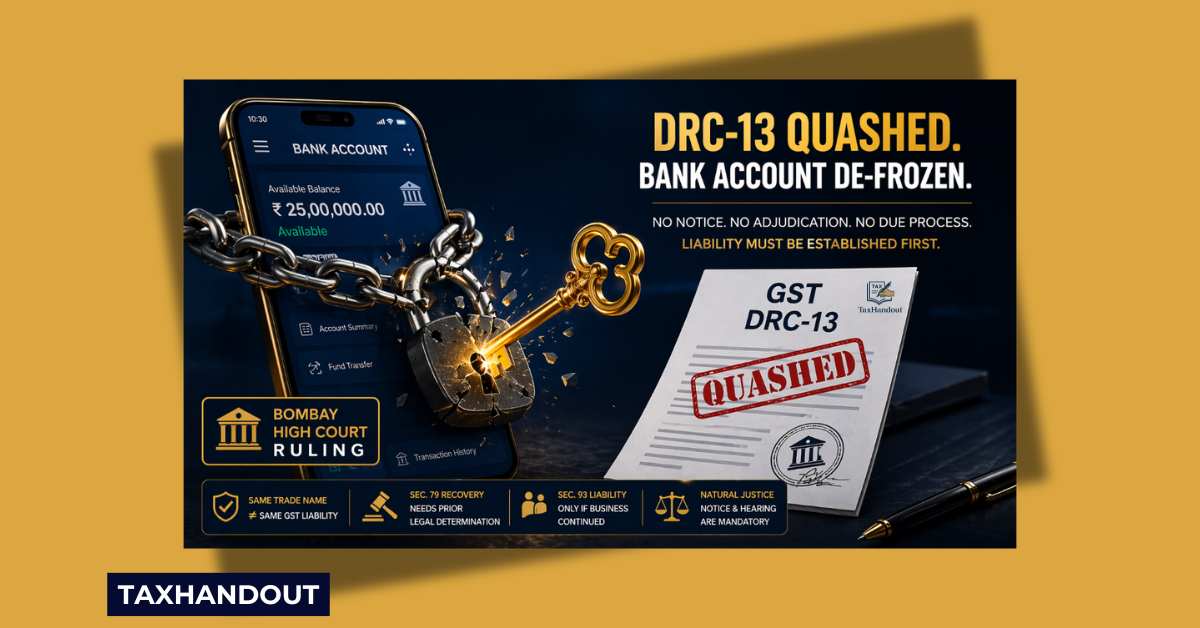
- Same trade name does not mean same legal entity
- Separate GST registrations indicate distinct taxable persons
- Liability under GST cannot be presumed
- Recovery under Section 79 requires prior legal determination
- Section 93 requires clear finding of business continuation
- Bank attachment without due process violates:
- Principles of Natural Justice
- Article 300A (Right to Property)
Final Order
The Bombay High Court:
- Quashed Form GST DRC-13
- Directed de-freezing of the bank account
- Allowed the department to:
- Initiate fresh proceedings
- Follow proper legal process
Father’s GST dues cannot be recovered from the son merely because both used the same trade name.
- Liability must be legally established
- Section 93 must be properly invoked
- Recovery under Section 79 must follow due process
Otherwise, such actions will not survive judicial scrutiny.