If you are providing services like:
- Freelance consulting
- IT services
- Graphic designing
- Digital marketing
- Content writing
- Online coaching
- Technical services
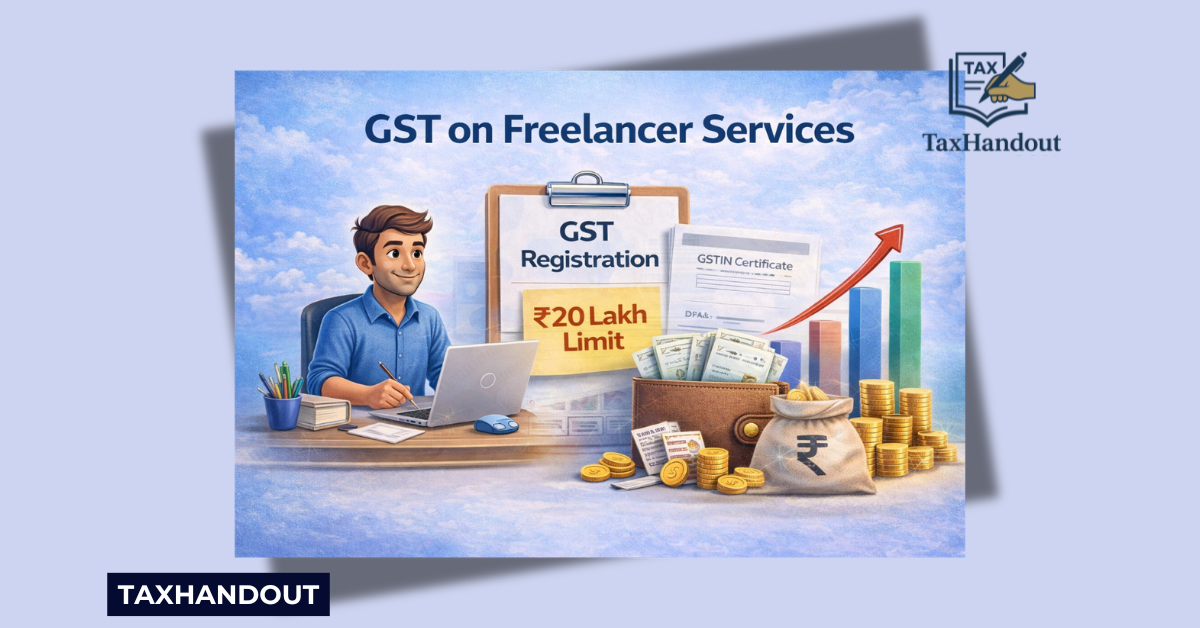
Then GST registration becomes mandatory when your aggregate turnover exceeds:
- ₹20 lakh in normal category states
- ₹10 lakh in special category states
This limit applies to service providers.
The moment your turnover crosses this limit during the financial year, you are legally required to apply for GST registration within 30 days.
No delay. No excuses.
What Is “Aggregate Turnover”?
Many freelancers misunderstand this.
Aggregate turnover includes:
- Taxable services
- Export of services
- Inter-state supplies
- Exempt supplies
It is calculated on a PAN basis, not client-wise.
If your total billing from 1 April crosses ₹20 lakh, registration becomes mandatory.
What Happens If You Don’t Register After Crossing ₹20 Lakh?
If you continue billing without GST after crossing the limit:
- You may receive a notice
- You may have to pay GST from the date of crossing the limit
- Interest and penalty may apply
- You cannot recover GST from past clients easily
This becomes a cash flow problem.
Should You Register Before ₹20 Lakh?
Legally, registration is mandatory only after ₹20 lakh.
But many smart freelancers voluntarily register between ₹12–15 lakh turnover.
Why?
Because of Input Tax Credit (ITC).
Real Benefit of Voluntary GST Registration
Freelancers typically incur expenses on:
- Laptop
- Mobile phone
- Internet bills
- Software subscriptions
- Cloud tools
- Office rent
- Professional tools
All these have GST.
Without registration, GST paid on these becomes a cost.
With registration, you can claim ITC and reduce your tax liability.
Professional Advantage of Having GSTIN
Beyond tax savings, GST registration gives:
- Better credibility with corporate clients
- Easier vendor onboarding
- Smooth payment processing
- Better eligibility for loans
- Business identity separation from personal finances
Today, many companies prefer vendors with GSTIN.
If you plan to grow, GST becomes a necessity — not just a compliance.
Important Practical Situations Where GST Is Required Even Before ₹20 Lakh
You must register irrespective of turnover if:
- You provide inter-state services in certain cases
- You supply through e-commerce operators
- You are liable under reverse charge
- You export services and want LUT benefits
Freelancers working with foreign clients often need GST registration for export compliance.
Do not wait for a notice.
Compliance should be proactive, not reactive.
GST registration is not just about crossing ₹20 lakh.
It is about:
- Tax efficiency
- Business credibility
- Future growth
- Avoiding penalties
If you are serious about scaling your freelance career, treat GST registration as a business decision not a burden.