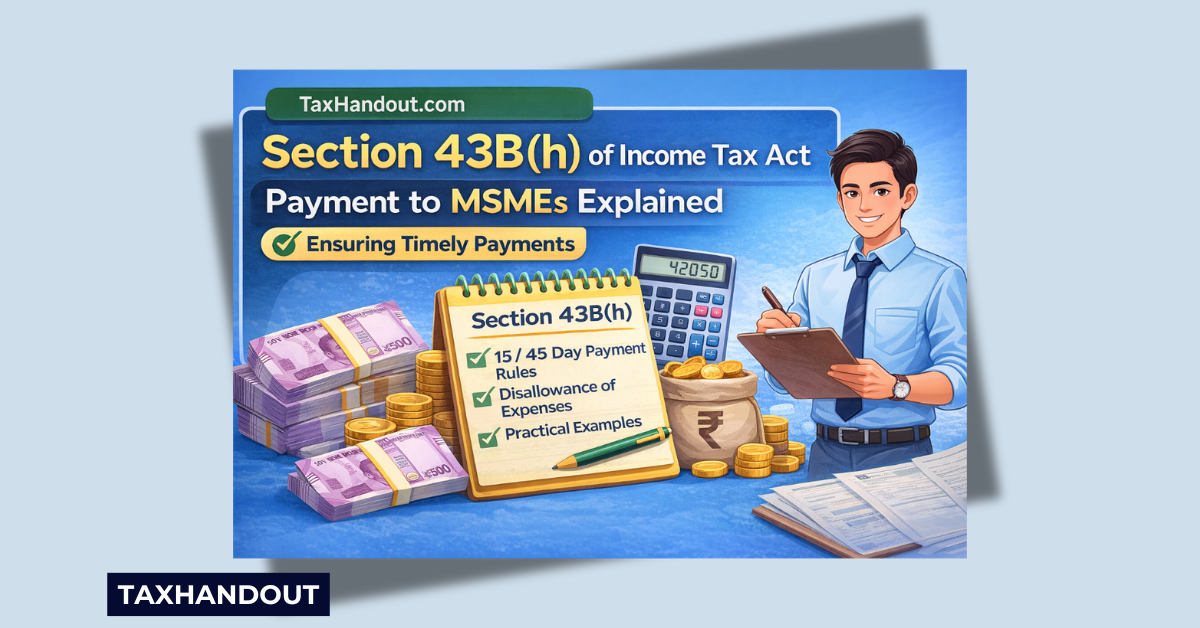
Businesses in India regularly purchase goods and services from Micro and Small Enterprises (MSMEs). To ensure that these small businesses receive timely payments, the government introduced Section 43B(h) in the Income Tax Act, 1961.
This provision has become one of the most important year-end tax compliance checks for businesses because failure to comply can lead to disallowance of expenses while calculating taxable income.
Simply put, if payment to MSME suppliers is not made within the prescribed time limit, the expense cannot be claimed as a deduction in that financial year.
Background of Section 43B(h)
Section 43B(h) was inserted by the Finance Act, 2023 to strengthen the provisions of the MSME Development Act, 2006.
The objective is to:
• Ensure timely payment to MSMEs
• Improve liquidity for small businesses
• Discourage delayed payment practices
Earlier, businesses could claim deduction even if payment to MSME vendors was pending. Now, deduction is allowed only if payment is made within the time limit prescribed under the MSMED Act.
As highlighted in the compliance note, payments to Micro or Small Enterprises must be made within the prescribed limits otherwise the expense will be disallowed for tax purposes.
What Does Section 43B(h) Provide?
Section 43B(h) states that:
Any amount payable to a Micro or Small Enterprise (MSE) for goods or services will be allowed as a deduction only if it is paid within the time limit prescribed under the MSMED Act, 2006.
If payment is made after the allowed period:
• Deduction will not be allowed in the current financial year
• Deduction will be allowed in the year when payment is actually made
Time Limit for Payment to MSMEs
Under the MSMED Act, the payment time limit is:
| Situation | Maximum Payment Period |
| Written agreement between buyer and MSME | 45 days |
| No written agreement | 15 days |
If payment exceeds these limits, the expense will be disallowed under Section 43B(h).
Applicability of Section 43B(h)
This provision applies to:
• Companies
• LLPs
• Partnership firms
• Proprietorship businesses
• Professionals claiming business expenditure
The supplier must be a registered Micro or Small Enterprise under Udyam Registration.
When Section 43B(h) Does NOT Apply
The section does not apply in the following cases:
- Payments to Medium Enterprises
- Payments to unregistered MSME suppliers
- Payments to MSME traders
- Payments made within the allowed period
These non-applicability conditions are also explained in the compliance summary prepared in the reference material.
Practical Example (FY 2025-26)
Example 1 – Payment within allowed time
| Particular | Details |
| Invoice Date | 15 July 2025 |
| Due Date under MSME Act (45 days) | 29 August 2025 |
| Actual Payment Date | 25 August 2025 |
Result:
Expense allowed in FY 2025-26
Example 2 – Payment after due date
| Particular | Details |
| Invoice Date | 15 July 2025 |
| Due Date under MSME Act | 29 August 2025 |
| Actual Payment Date | 10 April 2026 |
Result:
Expense disallowed in FY 2025-26
Deduction allowed in FY 2026-27 (year of payment).
Important Clarifications
Only Micro and Small Enterprises Covered
Medium enterprises are not covered under this provision.
MSME Registration Required
The supplier must have valid Udyam Registration.
Traders Not Covered
If the supplier is registered as a trader under MSME, Section 43B(h) does not apply.
Interest under MSMED Act
Delayed payments may attract compound interest at three times the RBI bank rate, which is not allowed as deduction under Income Tax.
Year-End Compliance Checklist (Before 31 March 2026)
Businesses should follow these steps before closing books for FY 2025-26:
Identify MSME Vendors
Collect Udyam registration certificates from suppliers.
Review Outstanding Payments
Check all creditors classified as Micro or Small Enterprises.
Track Payment Due Dates
Verify that payment is within 15 or 45 days.
Execute Written Agreements
Written agreements allow the maximum 45-day payment period.
Clear Outstanding Dues
Try to clear MSME dues before 31 March 2026 to avoid disallowance.
Section 43B(h) vs GST Rule – Key Difference
Many taxpayers confuse this provision with GST rules.
| Law | Provision | Time Limit | Consequence |
| Income Tax | Section 43B(h) | 15 / 45 days | Expense disallowed |
| GST | Rule 37 | 180 days | ITC reversal |
Both laws aim to encourage timely payment, but the tax consequences differ.
Section 37(2)(g) in New Income Tax Act 2025
Under the New Income Tax Bill 2025, the same concept is retained under:
Section 37(2)(g)
This provision continues the rule that deduction of expenses relating to MSMEs will be allowed only when payment is made within the time limit specified under the MSMED Act.
Thus, while the section number changes, the principle remains the same.
Businesses should:
• Identify MSME vendors
• Monitor payment timelines carefully
• Maintain written agreements
• Clear dues before year-end
Ignoring this provision can result in temporary disallowance of expenses and higher tax liability.
Proper compliance ensures both tax efficiency and support to MSME businesses in India.