
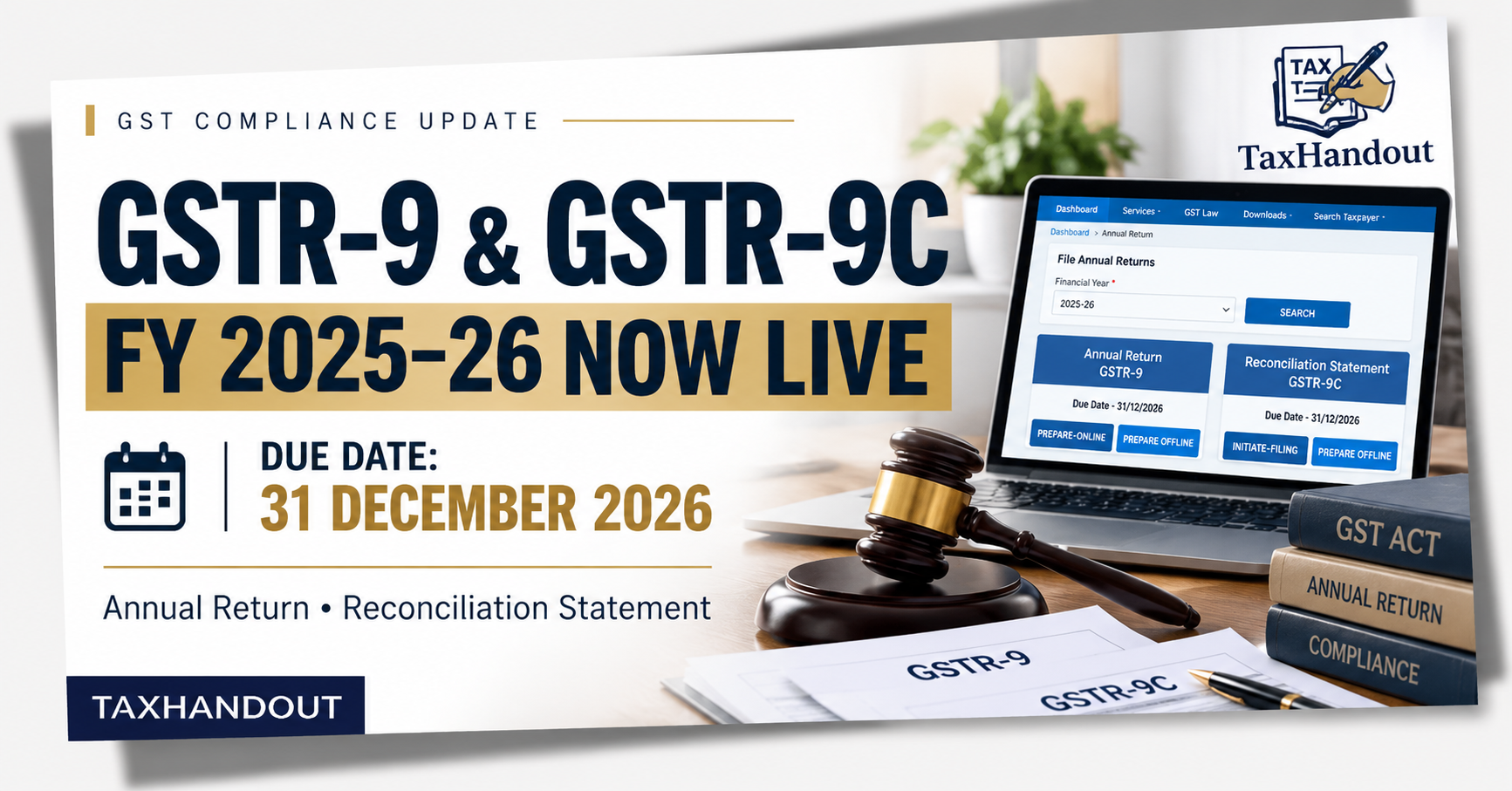
The GST portal has enabled Form GSTR-9 (Annual Return) and Form GSTR-9C (Reconciliation Statement) for Financial Year 2025-26. Eligible taxpayers should begin reconciling their GST returns with books of accounts and prepare for filing before the due date.
As per the portal information shown for FY 2025-26, the due date for both forms is 31 December 2026.
1. GSTR-9 and GSTR-9C: Key Details
| Particulars | Details |
|---|---|
| Financial Year | 2025-26 |
| Period Covered | 1 April 2025 to 31 March 2026 |
| Annual Return | Form GSTR-9 |
| Reconciliation Statement | Form GSTR-9C |
| Due Date | 31 December 2026 |
| Applicable Law | Section 44 of the CGST Act, 2017 and Rule 80 of the CGST Rules, 2017 |
Taxpayers should verify the applicable filing requirements for their GST registration before initiating the annual return process.
2. Who Is Required to File GSTR-9 and GSTR-9C?
The filing requirements depend on the taxpayer’s aggregate turnover and the applicable exemption.
A. Aggregate Turnover Up to ₹2 Crore
Registered persons having aggregate turnover of up to ₹2 crore in the relevant financial year are exempt from filing the annual return under Notification No. 15/2025–Central Tax dated 17 September 2025.
This exemption applies from FY 2024-25 onwards. Accordingly, eligible taxpayers for FY 2025-26 are not required to file GSTR-9.
B. Aggregate Turnover Above ₹2 Crore and Up to ₹5 Crore
Taxpayers whose aggregate turnover exceeds ₹2 crore but does not exceed ₹5 crore are generally required to file GSTR-9, subject to the applicable provisions.
GSTR-9C is not ordinarily required solely on the basis of turnover falling within this range.
C. Aggregate Turnover Above ₹5 Crore
Taxpayers whose aggregate turnover exceeds ₹5 crore during FY 2025-26 are generally required to furnish:
- Form GSTR-9 – Annual Return
- Form GSTR-9C – Reconciliation Statement, duly self-certified
Important: Aggregate turnover is calculated on an all-India basis for persons having the same PAN. The turnover threshold should not be assessed merely by looking at the turnover of an individual GSTIN.
3. Important Points to Remember Before Filing GSTR-9
1. GSTR-9 Cannot Be Revised
Once Form GSTR-9 has been filed, it cannot ordinarily be revised. Therefore, taxpayers should carefully review the figures before submitting the return.
Reconciliation should be completed before filing to minimise errors and inconsistencies.
2. Filing of Applicable Returns Is Mandatory
The GST portal requires all applicable returns and statements, including GSTR-1/IFF and GSTR-3B, to be filed before proceeding with the annual return.
If the portal displays a pending-return error, taxpayers should first identify and file the relevant outstanding returns.
3. ITC Details Require Careful Reconciliation
Input Tax Credit reported in GSTR-9 should be reconciled with GSTR-3B, GSTR-2B and the books of accounts.
For FY 2025-26, particular attention should be given to the auto-populated ITC figures and the underlying supplier records.
Differences may arise due to amendments, credit notes, debit notes, delayed reporting, reversals and reclaims.
4. GSTR-9C Is Self-Certified
Where applicable, GSTR-9C is a reconciliation statement that reconciles the figures reported in the annual return with the audited or annual financial statements, as relevant under the GST provisions.
For taxpayers covered by the applicable turnover threshold, the statement is self-certified.
4. Important ITC Deadline: 30 November 2026
Taxpayers should review any eligible Input Tax Credit relating to FY 2025-26 that has not yet been claimed.
Under Section 16(4) of the CGST Act, the general deadline for claiming eligible ITC in respect of invoices or debit notes pertaining to FY 2025-26 is 30 November 2026 or the date of furnishing the relevant annual return, whichever is earlier, subject to the applicable statutory conditions and exceptions.
Accordingly, taxpayers should not postpone ITC reconciliation until December 2026.
Review the following before the applicable deadline:
- Eligible purchase invoices not yet considered for ITC.
- ITC appearing in GSTR-2B but not claimed in GSTR-3B.
- ITC claimed in GSTR-3B but not reflected in the relevant reconciliation.
- Credit notes, debit notes and amendments.
- ITC reversals and subsequent reclaims.
- Ineligible ITC under Section 17(5) and other applicable provisions.
5. GST 2.0: Special Attention to Rate Changes from 22 September 2025
The revised GST rates effective from 22 September 2025 may affect the reporting and reconciliation of outward supplies, purchases and input tax credit for FY 2025-26.
Businesses should verify whether transactions around the rate-change date have been recorded using the correct tax rate and applicable time-of-supply provisions.
Special attention should be
6. GSTR-9 Late Fee for FY 2025-26
Late fee may apply if the annual return is not furnished within the prescribed due date.
For FY 2022-23 onwards, the applicable reduced late-fee structure for GSTR-9 is generally as follows:
| Aggregate Turnover | Combined Late Fee per Day (CGST + SGST/UTGST) | Maximum Combined Limit |
|---|---|---|
| Up to ₹5 crore | ₹50 | 0.04% of turnover in the State/UT |
| Above ₹5 crore and up to ₹20 crore | ₹100 | 0.04% of turnover in the State/UT |
| Above ₹20 crore | ₹200 | 0.50% of turnover in the State/UT |
The applicable turnover slab is determined using aggregate turnover for the relevant financial year, while the maximum limit is calculated with reference to turnover in the relevant State or Union Territory.
Where GSTR-9C is also required, the applicable rules regarding completion of the annual return and late fee should also be considered. Taxpayers should check the amount calculated on the GST portal and the applicable CBIC clarification before payment.
7. Practical Checklist for Taxpayers and Accountants
Before filing GSTR-9 and GSTR-9C, complete the following reconciliation:
- Reconcile outward supplies as per books with GSTR-1 and GSTR-3B.
- Reconcile tax liability, including amendments and credit notes.
- Match ITC claimed in GSTR-3B with GSTR-2B and purchase records.
- Review ITC reversals, reclaims and ineligible credits.
- Reconcile turnover as per financial statements with GST returns.
- Verify exempt, nil-rated, non-GST and export supplies, wherever applicable.
- Review reverse charge liability and tax payments.
- Check HSN-wise summaries and applicable tax rates.
- Verify the applicability of GSTR-9C based on aggregate turnover.
- Ensure all applicable GSTR-1/IFF and GSTR-3B returns have been filed.
- Complete the ITC review before the applicable statutory deadline.
- Review the final annual return carefully before submission.
8. How to File GSTR-9 and GSTR-9C on the GST Portal
Taxpayers can follow these general steps:
- Visit the official GST portal at https://www.gst.gov.in/.
- Log in using the registered credentials.
- Navigate to Services → Returns → Annual Return.
- Select Financial Year 2025-26.
- Click Search and review the filing status displayed for the relevant GSTIN.
- Select the appropriate option to prepare GSTR-9 online or offline.
- Complete the reconciliation and verify the auto-populated figures.
- File GSTR-9 after reviewing the return.
- Where GSTR-9C is applicable, prepare and furnish the reconciliation statement as prescribed.
Portal options and filing requirements may vary depending on the taxpayer’s eligibility and return status.
Conclusion
The availability of GSTR-9 and GSTR-9C for FY 2025-26 is a reminder for businesses and tax professionals to begin annual GST reconciliation well in advance.
Taxpayers should first determine whether GSTR-9 is mandatory or covered by the exemption for aggregate turnover up to ₹2 crore. Those required to file should reconcile their books, GST returns and input tax credit records before submission.
Important Dates to Remember
- 30 November 2026: General statutory deadline for eligible ITC claims relating to FY 2025-26, subject to Section 16(4).
- 31 December 2026: Due date for GSTR-9 and GSTR-9C as displayed on the portal, subject to any subsequent extension or applicable notification.
Early reconciliation can help reduce filing errors, identify missed eligible ITC and minimise the risk of late fees and subsequent GST disputes.
Disclaimer: This article is for general informational purposes. Taxpayers should refer to the CGST Act, CGST Rules, applicable notifications and circulars, and the GST portal for the latest requirements before filing.
Published by TaxHandout – GST & Income Tax Updates, Analysis and Simplified Guidance.