
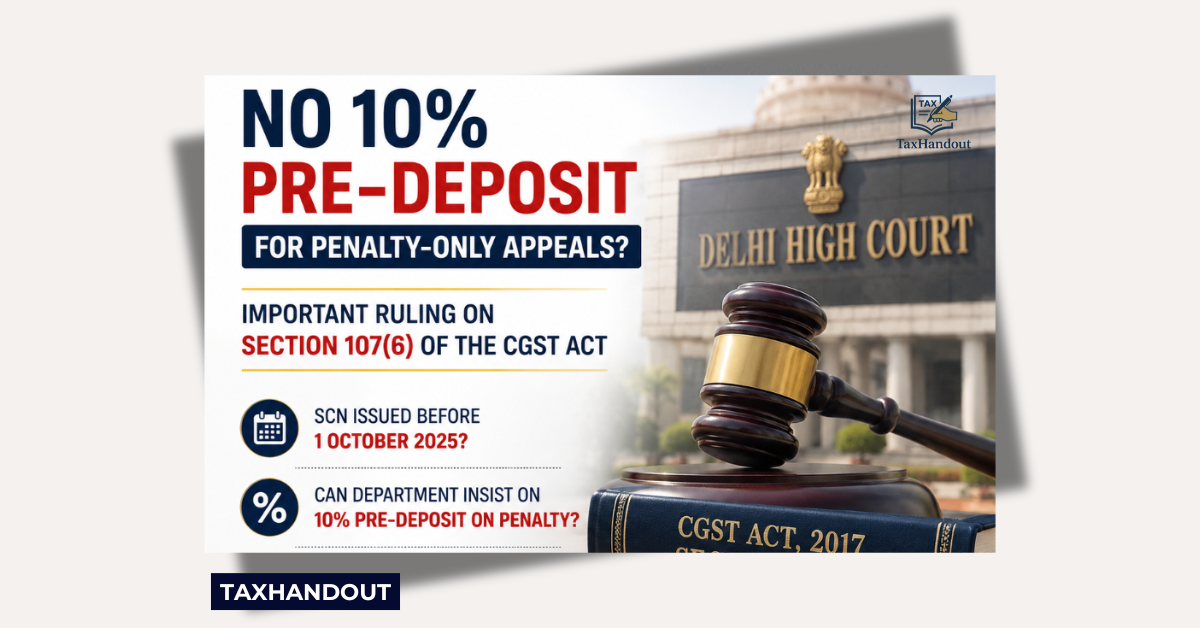
The Finance Act, 2025 brought a significant amendment to Section 107(6) of the CGST Act, 2017, making 10% pre-deposit mandatory even in cases involving only disputed penalty. This amendment came into effect from 1 October 2025.
A recent Delhi High Court decision in Gaurav Jain & Anr. v. Joint Commissioner (Appeals-II), CGST Delhi Zone has reportedly examined an important question:
Can this new pre-deposit requirement be applied to proceedings that started before 1 October 2025?
The Court reportedly answered No, holding that the amendment cannot be applied retrospectively. However, the official judgment was not independently available for verification at the time of writing. Readers should therefore rely on the certified copy of the judgment before citing it in litigation.
Section 107(6) – Pre-Deposit Requirement
Section 107 governs appeals before the First Appellate Authority.
Before filing an appeal, the appellant is required to:
Section 107(6)(a)
Deposit the amount of:
- Tax
- Interest
- Fine
- Fee
- Penalty
that is admitted by the appellant.
Section 107(6)(b)
Additionally, deposit the prescribed percentage of the disputed amount.
Position Before 1 October 2025
Prior to the amendment, Section 107(6) specifically required a 10% pre-deposit of the disputed tax amount.
Where an order contained only a penalty demand and there was no disputed tax, the law did not expressly require a percentage-based pre-deposit on the penalty component.
This created uncertainty in penalty-only cases under provisions such as:
- Section 122
- Section 122(1A)
- Section 129
- Other penalty provisions
Amendment by Finance Act, 2025
With effect from 1 October 2025, Parliament amended Section 107(6).
Now, where an appeal relates only to disputed penalty, the appellant must deposit:
10% of the disputed penalty amount
before the appeal can be entertained. This amendment was introduced through the Finance Act, 2025.
Facts of the Delhi High Court Case
According to reports of the decision:
- Show Cause Notice (SCN) was issued on 25 June 2025.
- This was before the amendment came into force.
- Appeal was filed after 1 October 2025.
- The Appellate Authority insisted upon 10% pre-deposit of penalty.
- The penalty involved was approximately ₹34.66 crore per petitioner.
- The taxpayers challenged this requirement before the Delhi High Court.
Issue Before the Court
The principal issue was:
Can the amended Section 107(6) be applied to proceedings initiated before 1 October 2025 merely because the appeal was filed after that date?
Delhi High Court’s View (As Reported)
The Court reportedly held that the answer is No.
The reasoning was based on the following legal principles.
1. Right of Appeal is a Substantive Right
The Court observed that the right to appeal is not merely procedural.
It is a substantive statutory right.
Therefore, the conditions governing an appeal become fixed when the legal proceedings commence.
2. Rights Crystallize on the Date of SCN
The Court reportedly held that the relevant date is:
the date on which adjudication proceedings begin, namely the issuance of the Show Cause Notice.
Since the SCN had been issued before 1 October 2025, the amended pre-deposit requirement could not be imposed.
3. No Retrospective Operation
The Court further observed that:
- Parliament did not expressly provide retrospective operation.
- A provision imposing an additional financial burden should not ordinarily operate retrospectively.
- Therefore, the amended proviso cannot be forced upon pending proceedings initiated before its commencement.
Relief Granted
According to reports, the Delhi High Court directed that:
- The appeal should be admitted without insisting upon 10% pre-deposit of disputed penalty.
- The matter should be considered under the unamended Section 107(6).
- Time spent in the writ proceedings should be excluded while computing limitation, and the petitioners were granted four weeks to complete the appeal formalities.
Practical Impact for Taxpayers
If this legal position is followed in future cases, it could provide significant relief.
The decision may be relevant where:
- Show Cause Notice was issued before 1 October 2025
- Appeal is filed after 1 October 2025
- Department insists on 10% pre-deposit of disputed penalty
- The dispute relates only to penalty
Such taxpayers may rely upon this principle, subject to the facts of their own case and the applicable judicial precedents.
Example
- SCN issued: 20 August 2025
- Order passed: December 2025
- Appeal filed: January 2026
Department demands:
10% of disputed penalty
Following the reasoning reported in this Delhi High Court decision, the taxpayer may contend that:
- proceedings commenced before the amendment,
- the appellate right had already crystallized,
- therefore the amended pre-deposit requirement should not apply.
Important Takeaways
✔ Finance Act, 2025 introduced 10% pre-deposit for penalty-only appeals with effect from 1 October 2025.
✔ The reported Delhi High Court decision indicates that the amendment should not operate retrospectively.
✔ The right to appeal is a substantive right, which generally crystallizes when adjudication proceedings commence.
✔ Taxpayers facing similar situations should carefully examine the date of the Show Cause Notice before making the pre-deposit.
Conclusion
The reported decision in Gaurav Jain & Anr. v. Joint Commissioner (Appeals-II), CGST Delhi Zone could become an important precedent on the applicability of the amended Section 107(6). If followed by other courts, it may prevent taxpayers from being compelled to make substantial penalty pre-deposits in cases where proceedings began before 1 October 2025.
Disclaimer: This article is based on the facts and legal propositions reported by the user and publicly available descriptions. Before relying on this decision in litigation or advisory work, readers should obtain and examine the certified or authenticated copy of the judgment.