A practical item-wise guide for businesses planning festive gifts, promotions and celebrations
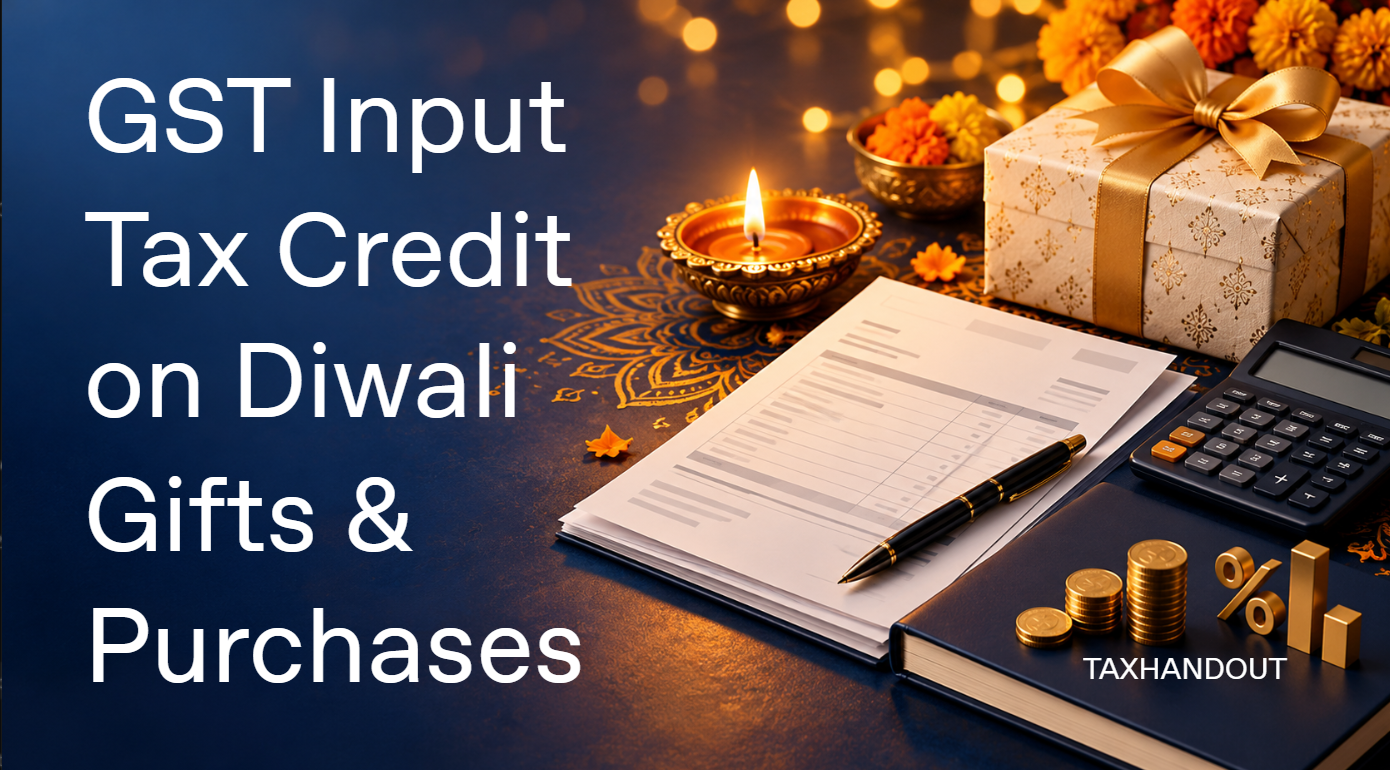
Diwali buying can create two different GST questions: must the business pay GST when it gives something away, and can it claim input tax credit (ITC) on the purchase? The answers do not always match. A genuine gift or free sample may not be an outward supply, while the GST paid on the item may still be blocked as credit. The safest approach is to classify the transaction by what it really is, keep a clear record of its purpose and apply the specific blocked-credit rules before claiming ITC.
Quick item-wise guide
| Purchase or arrangement | GST and ITC position | Practical treatment |
| Diwali gifts to employees | Gifts not exceeding ₹50,000 in value per employee in a financial year are not treated as supply under Schedule I. If the annual gift value exceeds ₹50,000, the gift may be a taxable supply when made in the course or furtherance of business. ITC on goods voluntarily given as gifts is generally blocked under section 17(5)(h); CBIC Circular 92 clarifies that ITC is available where the distribution itself is a Schedule I supply. | Track each employee’s aggregate gifts for the financial year. Separate voluntary gifts from benefits required by an employment contract. Do not treat the ₹50,000 threshold as an ITC threshold. |
| Hampers, sweets, dry fruits or gadgets given to customers, vendors or staff | A genuine no-charge gift is generally not a supply, unless Schedule I applies. ITC on goods disposed of by way of gift is blocked by section 17(5)(h). | Treat GST on the gifted goods as a cost in the ordinary case. Keep recipient and distribution records; check separately if the transfer is part of a taxable related-party or distinct-person supply. |
| Free samples | A free sample given without consideration is generally not a supply, except where Schedule I applies. ITC on goods used as free samples is blocked by section 17(5)(h). | Document the sample scheme and quantities. Circular 92/11/2019-GST addresses free samples and gifts. |
| Buy-one-get-one or a bundled festive offer | A genuine BOGO offer is treated as multiple supplies for one combined price, rather than one paid item plus a separate free gift. The tax treatment depends on whether the offer is a composite or mixed supply. Circular 92 says related ITC is available. | Show the offer clearly on invoices and records. Do not label a separately gifted item as BOGO if there is no linked purchase or combined pricing. |
| Festive discounts and price reductions | A discount linked to the supply is generally reflected in its taxable value; post-supply discounts have additional statutory conditions. ITC on ordinary resale inventory remains subject to section 16 and the normal restrictions. | Retain the offer terms, invoices and any credit-note documentation. A discount is not the same as giving away a separate item. |
| Gift vouchers or gift cards | CBIC Circular 243/37/2024-GST clarifies that a voucher is generally an instrument and transactions in the voucher itself are not a supply of goods or services; distribution or facilitation fees may be taxable. GST generally attaches to the underlying goods or services when redeemed. | Identify whether the instrument is a GST voucher, a payment instrument or simply cash. The circular does not create a blanket ITC entitlement for an employer’s purchase of vouchers to give away; review the underlying redemption and gift facts before claiming credit. |
| Food, sweets or catering for a Diwali event | Section 17(5)(b) generally blocks ITC on food and beverages and outdoor catering. The statutory exception can apply where providing the relevant goods or services is obligatory for the employer under a law in force, or where the inward supply is used for an eligible outward taxable supply of the same category. | For an employee or client celebration, assume ITC is blocked unless a specific statutory exception is evidenced. Circular 172/04/2022-GST confirms the employer-obligation proviso applies across clause (b). |
| Passenger motor vehicle purchased for business or as a festive reward | ITC on passenger vehicles with approved seating capacity of not more than 13 persons, including the driver, is generally blocked under section 17(5)(a), subject to exceptions such as further supply of such vehicles, passenger transportation or driving instruction. A vehicle given away as a gift raises an additional section 17(5)(h) issue. | Do not claim ITC merely because the vehicle is used for business or purchased in a festive scheme. Check seating, actual use, outward supplies and whether it is disposed of as a gift. |
| Demo vehicle held by an authorised dealer | CBIC Circular 231/25/2024-GST says ITC is not blocked where the authorised dealer uses the demo vehicle to promote further supply of similar vehicles on its own account. Credit is not available in the examples where the dealer uses the vehicle for staff transport or only provides marketing/test-drive services for a manufacturer without itself making the further supply. | Keep dealer agreements, purchase/sale records and evidence of the vehicle’s actual use. Capitalisation alone does not decide eligibility. |
| Office decoration, renovation or festive fit-out | Routine business-use purchases may qualify under section 16 if other conditions are met. But works contract services and goods or services used to construct an immovable property on the taxpayer’s own account are blocked under section 17(5)(c) and (d). Renovation, repairs and additions are included to the extent capitalised. | Separate removable decorations and routine consumables from capitalised work on the building. Review the accounting treatment and nature of the work; business use alone does not override the construction block. |
| Complimentary event or entertainment tickets | Section 17(5)(h) expressly addresses goods disposed of as gifts or free samples, so a service ticket is not automatically blocked by that clause. But ITC still requires business use and satisfaction of section 16; other specific blocks, personal-consumption concerns, the nature of the event and whether the ticket is part of a taxable outward supply can change the result. | Do not claim or reverse automatically based only on the word “complimentary”. Record the business purpose, recipient, event and whether the ticket relates to employees, customers or a taxable promotion; obtain a fact-specific review for material amounts. |
The legal caveats behind the table
The ₹50,000 employee-gift threshold is an annual GST supply rule, not a per-item limit and not a general ITC allowance. Schedule I says gifts not exceeding ₹50,000 in value in a financial year from employer to employee are not treated as a supply. A gift is generally voluntary, occasional and not enforceable as a right. A benefit promised under the employment contract is analysed separately: Circular 172/04/2022-GST states that contractual employee perquisites are not subject to GST. If the employee’s annual gift total crosses the threshold, the transaction should be reviewed for output GST and valuation; do not assume only the amount above ₹50,000 is taxable.
Promotional offers must be distinguished from gifts. Circular 92/11/2019-GST explains that free samples and gifts without consideration generally are not supplies and that related ITC is blocked under section 17(5)(h), unless the distribution falls within Schedule I. By contrast, a real BOGO offer is treated as multiple supplies for one price, with tax determined under the composite or mixed supply rules and ITC available for inputs used in the offer. The written offer, customer eligibility and invoice should tell the same story.
Vouchers now have specific CBIC guidance. Circular 243/37/2024-GST addresses whether voucher transactions are supplies, intermediary distribution and unredeemed balances. A voucher purchase for an employee or customer still needs a separate ITC analysis: do not infer credit eligibility merely because the voucher itself is not taxed at issuance. Identify what the voucher can be redeemed for and how the employer distributes it.
Food and catering credits are generally blocked even when the event is organised for business or employees. Section 17(5)(b) provides exceptions, including where the inward supply is used to make an outward taxable supply of the same category and where an employer is legally required to provide the benefit. Circular 172/04/2022-GST confirms that the employer-obligation proviso applies to the whole of clause (b). A voluntary Diwali meal is not, by itself, a legal obligation.
For renovations, the capitalisation test matters. The statutory explanation to section 17(5)(c) and (d) includes renovation, additions, alterations and repairs to the extent capitalised to the immovable property. A claim should distinguish building work from movable equipment or temporary decoration and should account for ownership, use and accounting treatment.
Motor vehicle restrictions are use-specific. For passenger vehicles with approved seating of up to 13 persons, the general block has limited statutory exceptions. Circular 231/25/2024-GST gives a specific path for a dealer’s demo vehicle used to promote further supply of similar vehicles on the dealer’s own account, and also explains cases where that logic does not apply. It is not a general exception for every test-drive or marketing vehicle.
Complimentary tickets need a facts-and-records approach. A ticket is ordinarily a right to a service, not goods disposed of as a gift under section 17(5)(h), but the general business-use rule and other blocked-credit provisions still apply. Employee entertainment, client hospitality, taxable promotions and personal use can produce different results. There is no blanket CBIC circular making every complimentary ticket eligible or ineligible.
A simple Diwali ITC check before filing
- Classify the transaction: gift, contractual employee benefit, sample, discount, bundled offer or taxable sale.
- Check the specific restriction in section 17(5), including gifts/free samples, food and catering, passenger vehicles, personal consumption and construction.
- For any claimed credit, retain a valid tax invoice and confirm the section 16 conditions, business use and return reporting are met.
- Keep employee-wise gift values, offer terms, recipient lists, event purpose, contracts and fixed-asset records together.
- Review high-value or unusual arrangements before distributing the items; a label such as “promotion” does not determine the GST result.
Conclusion
For Diwali purchases, the key is to separate the GST on the purchase from the GST consequences of giving the item away. Employee gifts may sit below the annual ₹50,000 supply threshold, yet ITC can still be restricted. Genuine bundled offers can be treated differently from free gifts, while food, passenger vehicles and capitalised renovation work have specific blocked-credit rules. Keep the commercial documents aligned with what actually happened and apply the relevant exception only when its conditions are supported.
Primary legal sources
- CGST Act, 2017, especially sections 16 and 17 and Schedule I (CBIC text)
- CBIC Circular No. 92/11/2019-GST, sales promotion schemes
- CBIC Circular No. 172/04/2022-GST, section 17(5) and employee perquisites
- CBIC Circular No. 231/25/2024-GST, demo vehicles
- CBIC Circular No. 243/37/2024-GST, vouchers
- CBIC Press Release, 10 July 2017, employer gifts and perquisites
Editorial note: This article is a general GST information guide based on the cited central law and CBIC materials reviewed on 27 October 2026. State GST adoption, later amendments, notifications and the specific facts of a transaction may affect the result. Obtain professional advice before acting on a material or disputed claim.