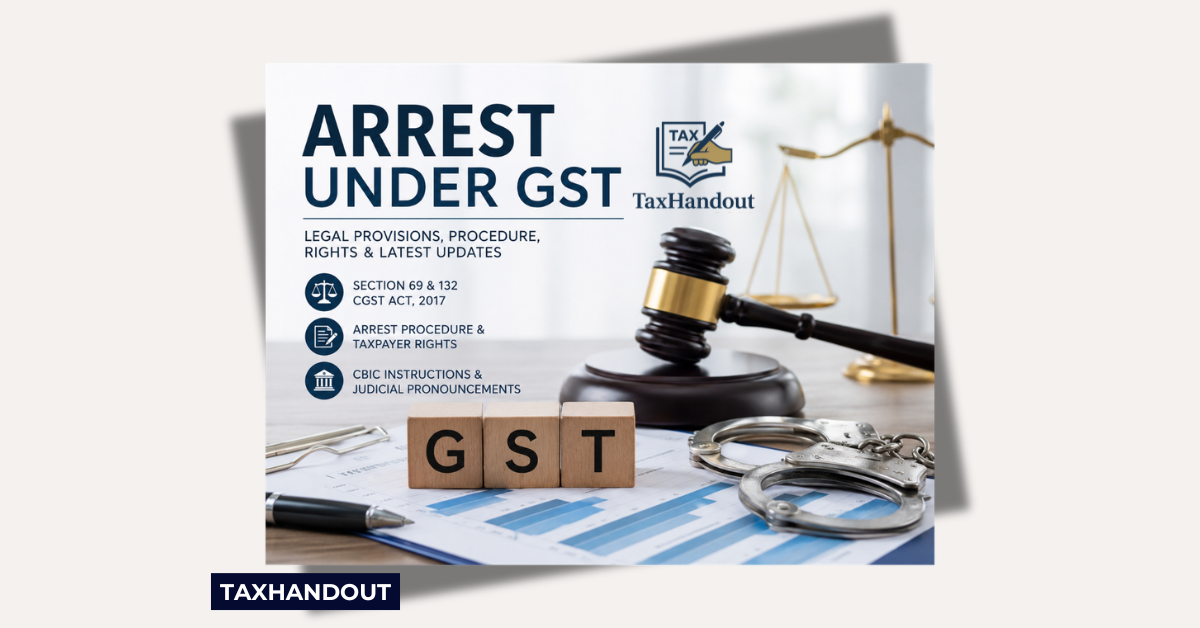
The power of arrest under GST is one of the most stringent enforcement mechanisms available to the tax authorities. Over the years, many taxpayers have received summons or notices and immediately feared arrest. However, arrest under GST is not intended to be a routine recovery tool.
The GST law permits arrest only in specified circumstances involving serious offences such as fake invoicing, fraudulent Input Tax Credit (ITC), bogus refund claims, and deliberate tax evasion.
Further, the Central Board of Indirect Taxes and Customs (CBIC) has issued detailed guidelines to ensure that arrest powers are exercised carefully and not arbitrarily. These safeguards were strengthened further through the amendment issued on 13 January 2025.
This handout explains the complete legal framework relating to arrest under GST, including Section 69, Section 132, arrest procedure, rights of taxpayers, CBIC guidelines, judicial pronouncements, and practical implications.
Legal Framework for Arrest Under GST
Two important provisions govern arrest under GST:
Section 69 – Power to Arrest
Section 69 empowers the Commissioner to authorize the arrest of a person if he has reasons to believe that such person has committed certain offences specified under Section 132 of the CGST Act.
The arrest can be authorized only by the Commissioner and cannot be made merely because a tax demand exists.
Section 132 – Punishment for Certain Offences
Section 132 specifies offences that may result in prosecution and imprisonment.
These include:
1. Supply Without Invoice
Supplying goods or services without issuing an invoice with the intention of evading tax.
2. Issuing Fake Invoices
Issuing invoices without actual supply of goods or services.
3. Availing Fake ITC
Taking Input Tax Credit based on fake or fraudulent invoices.
4. Collecting GST but Not Depositing It
Collecting tax from customers and failing to deposit it with the Government.
5. Fraudulent Refund Claims
Obtaining GST refunds through fraud or misrepresentation.
6. Falsification of Records
Destroying, tampering with, or suppressing books of accounts and records.
Meaning of “Reasons to Believe”
The phrase “reasons to believe” is very important.
The Commissioner must possess credible material showing involvement in a GST offence.
Arrest cannot be based merely on:
- Suspicion
- Guesswork
- Assumptions
- Mere difference of opinion
There must be evidence indicating commission of an offence covered under Section 132.
Can Arrest Be Made Before Assessment?
One common question is:
Can GST authorities arrest a person before final assessment or adjudication?
The answer is Yes.
Courts have consistently held that arrest is not necessarily dependent upon completion of assessment proceedings.
If sufficient evidence exists showing commission of offences under Section 132, arrest may be initiated even before tax liability is finally determined.
However, authorities must still satisfy all statutory safeguards.
Monetary Thresholds for GST Arrest
The seriousness of punishment depends upon the amount of tax involved.
| Amount of Tax Evasion | Maximum Punishment |
| Above ₹500 lakh | Up to 5 years imprisonment |
| ₹200 lakh to ₹500 lakh | Up to 3 years imprisonment |
| ₹100 lakh to ₹200 lakh | Up to 1 year imprisonment |
Cognizable and Non-Bailable Offences
Cognizable & Non-Bailable
Generally applicable where tax involved exceeds ₹5 crore in specified offences such as:
- Fake invoicing
- Fraudulent ITC
- Bogus refund claims
In such cases:
- Arrest can be made without warrant.
- Bail is granted by the Magistrate.
Non-Cognizable & Bailable
Where the offence does not fall in the above category:
- Bail can be granted by GST authorities.
- The accused has greater procedural protection.
CBIC Guidelines on Arrest
Instruction No. 02/2022-23 (GST-Investigation)
CBIC issued Instruction No. 02/2022-23 dated 17 August 2022 to regulate arrests under GST.
The Instruction emphasized that arrest should not be made routinely.
Important Principles
Arrest Should Not Be Mechanical
Officers must evaluate:
- Nature of offence
- Role of accused
- Evidence available
- Possibility of tampering with evidence
Arrest Is Not a Recovery Tool
The purpose of arrest is not merely to recover tax.
Serious Cases Only
Arrest should generally be considered in cases involving:
- Fake invoicing
- Fraudulent ITC
- Bogus firms
- Deliberate tax fraud
Important Amendment – 13 January 2025
Instruction No. 01/2025-GST
CBIC amended the above guidelines through Instruction No. 01/2025-GST dated 13 January 2025.
This amendment was issued following judicial observations emphasizing protection of constitutional rights of taxpayers.
Written Grounds of Arrest Made Mandatory
One of the most significant changes introduced by the amendment is:
Before 13 January 2025
The arrested person was informed about grounds of arrest.
After 13 January 2025
GST officers must:
- Inform the grounds of arrest.
- Provide the grounds of arrest in writing.
- Attach the written grounds to the Arrest Memo.
- Obtain acknowledgement from the arrested person.
This amendment significantly strengthens procedural safeguards and transparency.
Arrest Procedure Under GST
The normal arrest procedure is as follows:
Step 1 – Collection of Evidence
Investigation wing gathers evidence.
Step 2 – Formation of Reason to Believe
Commissioner examines material.
Step 3 – Authorization of Arrest
Written authorization is issued.
Step 4 – Arrest Memo
Arrest Memo is prepared.
Step 5 – Communication of Grounds
Grounds of arrest must be communicated and provided in writing.
Step 6 – Informing Family Member
Relative, friend, or authorized person should be informed.
Step 7 – Medical Examination
Where necessary, medical examination is conducted.
Step 8 – Production Before Magistrate
For non-bailable offences, the arrested person is produced before the Magistrate within the prescribed period.
Rights of an Arrested Person
GST law does not override constitutional protections.
Every arrested person has the following rights:
Right to Know Grounds of Arrest
The person must be informed of reasons for arrest.
Right to Receive Written Grounds
Mandatory after the 13 January 2025 amendment.
Right to Legal Representation
The person may consult an advocate.
Right Against Illegal Detention
Authorities cannot keep a person in custody indefinitely.
Right to Medical Examination
Medical safeguards must be provided where required.
Right to Bail
Available depending upon the nature of offence.
Supreme Court Judgment in Radhika Agarwal Case
The Supreme Court in the matter of Radhika Agarwal v. Union of India examined the constitutional validity of GST arrest and summons provisions.
The Court upheld:
- Section 69 (Arrest)
- Section 70 (Summons)
However, the Court emphasized:
- Exercise of power must be fair.
- Procedural safeguards must be followed.
- Constitutional protections remain available.
- Arrest cannot become a tool of harassment.
This judgment has become a landmark authority governing GST investigations.
Practical Situations – When Arrest Is Likely?
| Situation | Arrest Possible? |
| Genuine classification dispute | No |
| Valuation dispute | No |
| Difference in legal interpretation | No |
| Clerical error in return | No |
| Fake invoice racket | Yes |
| Bogus ITC network | Yes |
| Fake firms created for GST fraud | Yes |
| Fraudulent refund claim | Yes |
| Tax collected but intentionally not deposited | Yes |
Important Takeaways for Taxpayers
- Arrest under GST is an exceptional power.
- Every tax dispute does not lead to arrest.
- Fake invoices and fraudulent ITC remain the primary focus areas.
- Commissioner must have reasons to believe.
- CBIC guidelines prohibit routine arrests.
- Written grounds of arrest are now mandatory.
- Taxpayers have constitutional and legal safeguards.
- Courts closely scrutinize misuse of arrest powers.
Arrest under GST is one of the most powerful enforcement tools available to the tax authorities, but it is intended only for serious cases involving fraud, fake invoicing, bogus ITC claims, fraudulent refunds, and deliberate tax evasion.
The issuance of Instruction No. 02/2022-23 and its amendment through Instruction No. 01/2025-GST dated 13 January 2025 demonstrates the Government’s intent to balance tax enforcement with taxpayer rights. The requirement to provide written grounds of arrest is a significant safeguard that promotes transparency and accountability.
For genuine taxpayers involved in classification disputes, valuation issues, or interpretational differences, arrest should generally not be a concern. However, businesses must maintain proper documentation, ensure the genuineness of transactions, and avoid arrangements that may expose them to allegations of tax fraud.
A well-informed taxpayer is the best defence against unnecessary litigation and enforcement action under GST.