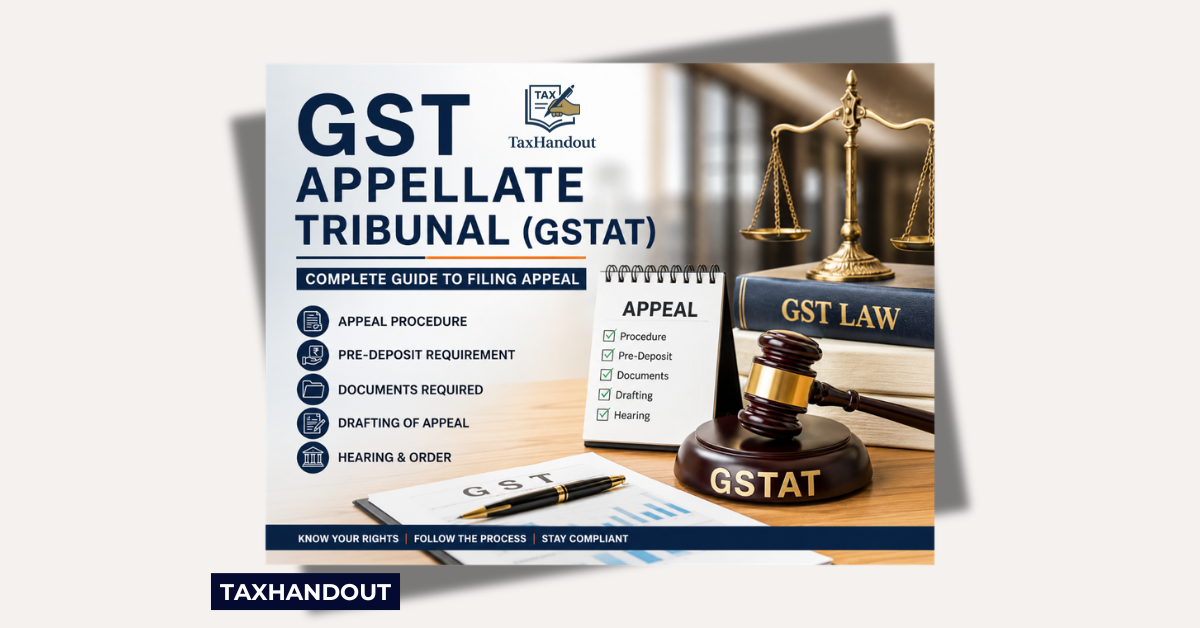
All GST orders communicated before April 1, 2026 must be challenged at GSTAT by June 30, 2026. This covers an estimated 4 lakh+ pending first-appeal orders. Missing this deadline will require a separate condonation application, which is entirely at the Tribunal’s discretion.
After receiving an adverse order from the GST Department, many taxpayers are left wondering: Can I challenge this? Where? How much do I need to deposit? What documents are needed?
The answer lies in filing an appeal before the GST Appellate Tribunal (GSTAT) — India’s dedicated second-tier appellate forum for GST disputes. After eight years of waiting, GSTAT is now fully operational. This guide explains everything a taxpayer needs to know in plain language.
What is the GST Appellate Tribunal (GSTAT)?
The GST Appellate Tribunal (GSTAT) is the second appellate authority under GST law, established under Section 109 of the CGST Act, 2017. It is an independent judicial forum that hears disputes between taxpayers and the GST Department after the first appeal stage.
GSTAT was formally launched by Finance Minister Nirmala Sitharaman on September 24, 2025, and began adjudicatory operations on February 16, 2026 with the Principal Bench at New Delhi and several State Benches becoming functional. The Finance Minister described it as India moving from “One Nation, One Tax” to “One Nation, One Forum for Fairness and Certainty.”
Importantly, GSTAT is the final fact-finding forum in the GST appellate chain. Appeals beyond GSTAT (to High Court / Supreme Court) can only raise questions of law — not facts.
⚖️ Constitutional Basis
GSTAT derives its footing from Article 323B of the Constitution of India, which empowers Parliament to establish tribunals for adjudication of tax disputes. Its statutory basis is Section 109 of the CGST Act, 2017.
Bench Structure & Jurisdiction
GSTAT operates through a two-tier geographic structure — 1 Principal Bench in New Delhi and 31 State Benches across 45 locations, including circuit benches.
🏛️ Principal Bench — New Delhi
- World Trade Centre, Nauroji Nagar, New Delhi
- Presided by President: Justice Sanjaya Kumar Mishra
- Exclusive jurisdiction: place-of-supply disputes
- Appeals of national / pan-India significance
- National Appellate Authority for Advance Rulings (NAAAR) from April 2026
- Further appeal: Supreme Court (law only)
🗺️ State Benches — 31 Benches
- Each bench: 2 Judicial + 2 Technical Members
- Your bench = your GSTIN registration state
- Circuit benches at additional locations
- Handles all state-level GST disputes
- Further appeal: High Court (factual remand possible)
- All appeals filed at efiling.gstat.gov.in
📌 Division Bench Rule — May 2026 Update
As per GSTAT order dated May 14, 2026, all pending and future filings before both the Principal Bench and State Benches shall first be listed before a Division Bench. Matters involving tax liability below ₹50 lakh with no question of law may subsequently be referred to a Single Bench with the President’s approval.
GST Litigation Hierarchy — Where Does GSTAT Fit?
| Stage | Authority | Legal Provision | Remarks |
|---|---|---|---|
| 1 | Adjudicating / Proper Officer | Section 73 / 74 | Original demand order issued here |
| 2 | First Appellate Authority (Commissioner Appeals) | Section 107 | 10% pre-deposit of disputed tax required |
| 3 | ⚖️ GST Appellate Tribunal (GSTAT) | Section 112 | Additional 10% pre-deposit (max ₹20 Cr CGST) |
| 4 | High Court | Section 117 | Questions of law only (State Bench appeals) |
| 5 | Supreme Court | Section 118 | Questions of law only (Principal Bench appeals) |
⚠️ Do Not Skip GSTAT and Go Directly to High Court
With GSTAT now operational, High Courts are increasingly refusing to entertain fresh Writ Petitions under Article 226 for GST matters where a statutory appeal remedy exists before GSTAT. Always exhaust the GSTAT remedy first.
When Can You File an Appeal Before GSTAT?
An appeal before GSTAT can be filed against:
- Orders passed by the First Appellate Authority (Commissioner Appeals) under Section 107
- Orders passed by the Revisional Authority under Section 108
- Certain other orders passed by State Bench or Area Bench as prescribed
📋 Who Can File?
Both taxpayers (aggrieved by an appellate/revisional order) and the Department (GST Commissioner) can file appeals before GSTAT. Importantly, no pre-deposit or court fee is payable in appeals filed by the Revenue/Department authorities.
Time Limits for Filing Appeal
Taxpayer (Normal)
3 Months
From date of communication of the appellate order (for orders served on/after April 1, 2026)
Department
6 Months
From the date of communication of the order to the Commissioner
🚨 Special Deadline: Backlog Cases (Orders Before April 1, 2026)
🔴 June 30, 2026 — Final Statutory Deadline for All Backlog Cases
For all GST orders communicated or served before April 1, 2026, the appeal must be filed before GSTAT by June 30, 2026. This covers the massive backlog of 4 lakh+ first-appeal orders accumulated during the 8 years GSTAT was non-operational. This is a hard statutory cutoff — do not delay.
Delay Condonation
The Tribunal has discretionary power to condone delay if sufficient cause is shown. However, taxpayers must never rely on condonation — the Tribunal’s discretion is not guaranteed. Always file within the prescribed period.
📅 GSTAT Portal Filing Relaxation — Extended to December 31, 2026
As per GSTAT Principal Bench order dated May 14, 2026, relaxed scrutiny norms for the e-filing portal have been extended until December 31, 2026. Scrutiny officers will not raise defects where appellants upload soft copies of essential documents — SCN, Order-in-Original, Order-in-Appeal, Statement of Facts, Grounds of Appeal, pre-deposit proof, and court fee documents. Scanned certified copies are accepted if properly endorsed by the issuing authority.
Pre-Deposit Requirements — How Much Must You Pay?
Pre-deposit is a mandatory condition for filing an appeal. The appeal will be rejected at the registry stage if the correct pre-deposit is not paid.
| Stage | Pre-Deposit Required | Maximum Cap (CGST) |
|---|---|---|
| First Appeal — Section 107 | 10% of disputed tax (+ entire admitted tax) | ₹25 Crore |
| GSTAT Appeal — Section 112 (Additional) | Additional 10% of disputed tax | ₹20 Crore |
| Cumulative Total | 20% of disputed tax | Separate caps apply under SGST |
Worked Example — ₹50 Lakh GST Demand
Pre-Deposit Calculation
| Total GST Demand | ₹50,00,000 |
| First Appeal Deposit (10%) | ₹5,00,000 |
| GSTAT Additional Deposit (10%) | ₹5,00,000 |
| ✅ Total Cash Deposited | ₹10,00,000 (20%) |
Critical Rules on Pre-Deposit Payment
- Payment must be made via theBharatkosh portal(online or offline modes)
- Payment fromElectronic Credit Ledger (ITC) is strictly NOT permitted— only Electronic Cash Ledger
- Amounts deposited under High Court interim orders (when GSTAT was non-operational) will be adjusted against the 20% cumulative requirement
- The pre-deposit base isdisputed tax only— interest and penalty are excluded from the 10% calculation
- Court fee:₹1,000 per ₹1 lakh of disputed tax, capped at ₹25,000, paid via Bharatkosh
✅ Automatic Stay on Recovery
Once the prescribed pre-deposit is made and the appeal is filed, recovery of the remaining disputed amount is automatically stayed under Section 112 of the CGST Act. No separate stay application is required at the GSTAT stage.
How to File: Step-by-Step Online Process
All appeals must be filed electronically on the GSTAT portal at efiling.gstat.gov.in in Form APL-05. Physical / manual filing is not permitted unless specifically allowed by the Registrar.
- Compute Pre-Deposit & Pay via Bharatkosh Calculate 10% of disputed tax (additional to first-appeal deposit) and court fee. Pay via Bharatkosh online or offline. Download the challan/payment confirmation.
- Prepare Form APL-05 & All Documents Draft Statement of Facts and Grounds of Appeal. Compile all supporting documents. All PDFs must be paginated, indexed, and bookmarked per GSTAT Procedure Rules, 2025 (max 20 MB per file).
- Login to GSTAT e-Filing Portal Access efiling.gstat.gov.in using your GST credentials. Select the correct State Bench based on your GSTIN registration state. For place-of-supply disputes only, select the Principal Bench.
- Upload Documents & Digitally Sign Upload the JSON file from the offline utility. Attach all documents and authorization letter / vakalatnama for your CA or advocate. Digitally sign using DSC or Aadhaar e-Sign.
- Submit & Receive Acknowledgement The portal generates a provisional acknowledgement with the appeal number. This date is treated as the official filing date for limitation purposes.
- Registry Scrutiny & Defect Removal The Registrar scrutinises the filing. Under the extended relaxation (valid till December 31, 2026), only substantive defects are raised. Minor technical issues on soft copies are being waived.
Documents Required for GSTAT Appeal
Under GSTAT instructions updated in March 2026, the following documents must be uploaded along with Form APL-05:
🔑 Mandatory Documents
- Show Cause Notice (SCN)
- Order-in-Original (OIO)
- Order-in-Appeal (OIA)
- Statement of Facts
- Grounds of Appeal
- Pre-deposit proof (Bharatkosh challan)
- Court fee payment proof
- Authorization Letter / Vakalatnama
🪪 Identity & Registration
- GST Registration Certificate
- PAN Card of the entity
- Aadhaar of Authorized Signatory
- Board Resolution (for companies)
- DRC-03 copies (if applicable)
- Electronic Cash Ledger extract
- Electronic Liability Ledger extract
📊 Financial & Compliance Records
- GSTR-1 and GSTR-3B returns
- Books of accounts (relevant excerpts)
- Reconciliation statements
- Reply filed before Department
- Additional submissions filed earlier
- Hearing notices and Department’s orders
📦 Transaction Evidence
- Tax invoices (disputed transactions)
- E-way bills
- Purchase / sale records
- Agreements / contracts
- Import/export documents (if applicable)
- Any other evidence relevant to the dispute
📎 Document Formatting Requirement
All PDFs must be paginated, indexed, and bookmarked as per GSTAT Procedure Rules, 2025. Maximum file size is 20 MB per document. Scanned certified copies of orders are accepted if properly endorsed by the issuing authority.
How to Draft the GSTAT Appeal (Form APL-05)
A well-drafted appeal is the single most important factor in determining the outcome. Each ground must identify the exact provision of law violated, the specific error committed, and the precise relief sought.
Structure of the Appeal
- Cause Title— Appellant’s name, GSTIN, address, and appeal number
- Brief Facts of the Case— Nature of business, background, issue, demand raised (chronological order)
- Statement of Facts— Dates of SCN, reply, adjudication order, first appeal order, appellate order
- Grounds of Appeal— Legal and factual grounds (most critical section — see below)
- Prayer Clause— Each specific relief requested
Key Categories of Grounds
| Category | Common Grounds |
|---|---|
| Procedural / Natural Justice | No opportunity of hearing; non-speaking / cryptic order; violation of principles of natural justice; invalid / vague SCN |
| Legal / Jurisdiction | Demand time-barred (limitation); lack of jurisdiction; improper service of notice; extended period invoked without suppression or fraud |
| ITC Disputes | Supplier default (taxpayer not liable); Rule 36 disputes; fake invoice allegations — evidence rebuttal; 2A/2B mismatch |
| Demand Matters | Section 73 / 74 demands wrongly raised; classification dispute — correct HSN code; valuation dispute — transaction value correct |
| Exemption / Penalty | Exemption wrongly denied; penalty — no suppression, fraud, or mens rea; interest wrongly levied |
Standard Prayer Clause
- The impugned order be set aside / quashed in totality
- The demand of tax be deleted / reduced
- Interest confirmed be deleted
- Penalty imposed be deleted
- Pre-deposit be refunded with interest upon final disposal
- Any other relief deemed fit and proper in the facts and circumstances of the case
💡 Always Cite Judicial Precedents
Every ground must be supported by relevant High Court / Supreme Court judgments and applicable CBIC Circulars or Notifications. A ground without judicial support carries significantly less weight before the Tribunal. Research thoroughly before filing.
Can Fresh Evidence Be Filed Before GSTAT?
Yes. The Tribunal can admit additional evidence with permission, if the appellant demonstrates that it could not have been produced before the lower authorities despite due diligence, or if the lower authority improperly refused to admit it.
Hearing Process Before GSTAT
Hearings are conducted under Rules 41 to 52 of the GSTAT Procedure Rules, 2025, upholding principles of fair hearing, procedural propriety, and natural justice.
- 1Appeal Filed on GSTAT PortalProvisional acknowledgement generated. This date is the official filing date for limitation purposes.
- 2Registry ScrutinyRegistrar / Deputy Registrar examines completeness. Defect notice issued if deficiencies found.
- 3Removal of DefectsAppellant must cure defects within the prescribed period. Failure can result in dismissal.
- 4Listed Before Division BenchAs per May 2026 order, all cases first go before a Division Bench. Small cases (below ₹50 lakh, no question of law) may be assigned to Single Bench thereafter.
- 5Admission HearingTribunal considers maintainability. If admitted, notice is served on the other side (Department).
- 6Final ArgumentsBoth parties make oral arguments. Additional evidence or affidavits may be filed with the Tribunal’s permission.
- 7Pronouncement of OrderOrder pronounced in open court or uploaded on the portal. This is the final factual determination — only questions of law can be appealed further.
Pre-Filing Checklist — Verify Before You Submit
- Confirm whether the June 30, 2026 backlog deadline or normal 3-month limit applies to your case
- Calculate pre-deposit correctly — 10% of disputed tax only (not interest/penalty), paid via Bharatkosh Cash Ledger
- Pay court fee — ₹1,000 per ₹1 lakh of disputed tax, capped at ₹25,000
- Review the first appellate order in full — identify each finding to be specifically challenged
- Prepare a complete chronology of the entire dispute
- Collect all supporting evidence — invoices, returns, reconciliation statements
- Research and cite favourable High Court and Supreme Court judgments for each ground
- Cite relevant GST Circulars and Notifications supporting your position
- Draft precise, specific grounds — vague or generic grounds are insufficient
- Execute authorization letter / vakalatnama in favour of your CA or advocate
- Paginate, index, and bookmark all PDF documents as required by GSTAT rules
- Confirm correct Bench selection — State Bench for most matters; Principal Bench for place-of-supply disputes only
- Upload complete annexures — missing documents cause significant delay in hearing
Common Mistakes That Can Sink Your Appeal
| Mistake | Consequence |
|---|---|
| Missing the June 30, 2026 backlog deadline | Requires separate condonation application — discretionary, not guaranteed |
| Paying pre-deposit from ITC / Electronic Credit Ledger | Pre-deposit not valid; appeal rejected at registry |
| Including interest and penalty in the 10% base calculation | Computation error — underpayment or overpayment |
| Vague or generic grounds of appeal | Grounds may be rejected; adverse findings sustain |
| Not challenging each adverse finding specifically | Unfought findings are treated as accepted and become final |
| Missing annexures or unindexed documents | Defect notice issued; significant delay in hearing |
| Filing before wrong bench (e.g. place-of-supply before State Bench) | Dismissed for lack of jurisdiction — re-filing required |
| Going directly to High Court bypassing GSTAT | High Courts now regularly dismissing Writ Petitions where GSTAT remedy is available |
| Not uploading authorization letter / vakalatnama | Mandatory under current instructions; appeal marked defective |
Conclusion
The GST Appellate Tribunal is a watershed moment for Indian indirect tax jurisprudence — finally giving taxpayers a dedicated, independent, specialist forum between the first appellate authority and the High Court. With over 4 lakh cases potentially in the pipeline and a firm June 30, 2026 deadline for backlog cases, early action is not merely advisable — it is essential.
A successful GSTAT appeal requires timely filing, correct pre-deposit via the right channel, comprehensively documented grounds, specific challenge to each adverse finding, and well-researched judicial precedents. Treat every GSTAT filing as serious litigation.
⏰ Critical Reminder: June 30, 2026 is the final deadline for all pre-April 2026 orders.
Disclaimer: This article is for general informational purposes only and does not constitute legal or tax advice. Taxpayers should consult a qualified CA, tax advocate, or legal professional for advice specific to their matter. All information is current as of June 2026; provisions may be amended subsequently.