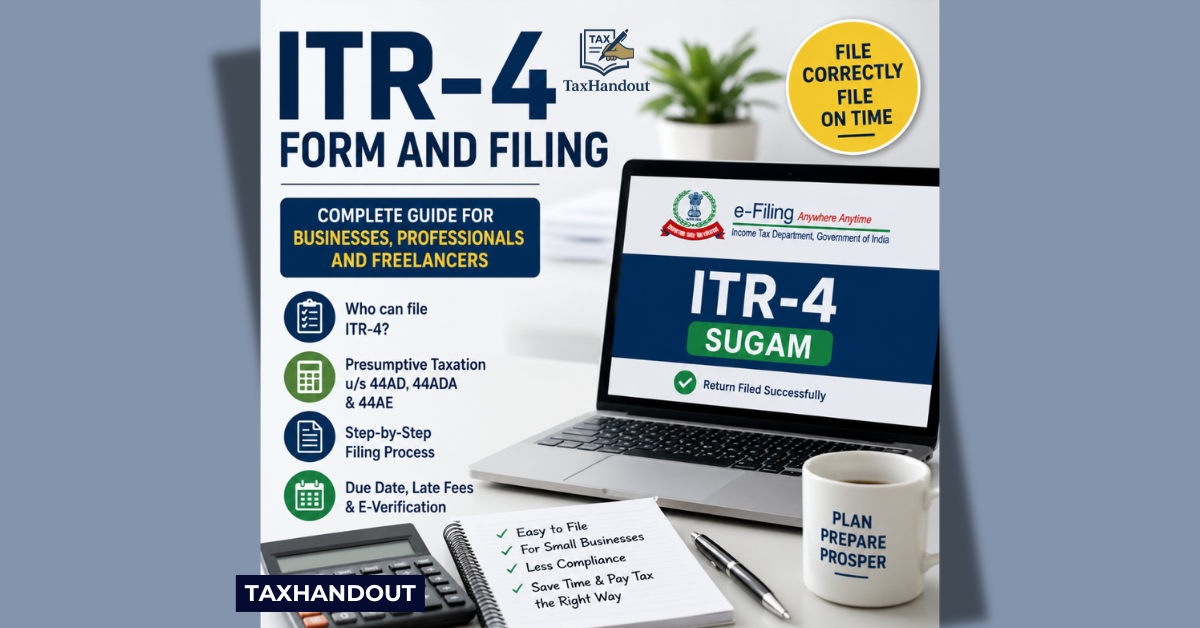
ITR-4, also known as Sugam, is one of the most commonly used income tax return forms for small business owners, freelancers, professionals and transporters in India. It is mainly meant for taxpayers who declare income under the presumptive taxation scheme under Sections 44AD, 44ADA or 44AE of the Income-tax Act.
If you are running a small business, providing professional services, freelancing, or operating goods vehicles, ITR-4 may be the correct return form for you. However, choosing the wrong ITR form can lead to defective return notices, processing delays or compliance issues.
What is Form ITR-4 ?
ITR-4, or Sugam, is a simplified income tax return form for resident individuals, HUFs and firms other than LLPs who have income up to ₹50 lakh and declare business or professional income on a presumptive basis. The Income Tax Department states that ITR-4 is applicable where income is computed under Sections 44AD, 44ADA or 44AE, along with certain other eligible income sources.
In simple words, ITR-4 is useful for taxpayers who do not want to maintain detailed books of accounts and are eligible to declare income at a fixed percentage or amount under presumptive taxation.
Who is Eligible to File ITR-4?
ITR-4 can generally be filed by:
- Resident individual
- Resident HUF
- Resident partnership firm, other than LLP
- Taxpayer having total income up to ₹50 lakh
- Taxpayer having business income under Section 44AD
- Professional income under Section 44ADA
- Income from goods carriage business under Section 44AE
- Salary or pension income
- Income from one house property
- Income from other sources such as bank interest, FD interest, family pension, etc.
- Agricultural income up to ₹5,000
- LTCG under Section 112A up to ₹1.25 lakh, subject to prescribed conditions and no brought-forward or carry-forward capital loss.
Who Cannot File ITR-4?
You cannot file ITR-4 if:
- You are a non-resident or RNOR
- Your total income exceeds ₹50 lakh
- You are a director in a company
- You hold unlisted equity shares
- You have income from more than one house property
- You have capital gains other than eligible LTCG under Section 112A up to ₹1.25 lakh
- You have agricultural income above ₹5,000
- You have income from lottery, race horses or speculative income
- You have foreign assets or foreign income
- You are an LLP
- You are required to maintain detailed books and file ITR-3
- You have brought-forward losses or losses to be carried forward
If your income structure is complex, do not force-fit your case into ITR-4. Consult a tax professional and file the correct ITR form.
Presumptive Taxation under Sections 44AD, 44ADA and 44AE
Section 44AD: Small Businesses
Section 44AD applies to eligible resident individuals, HUFs and partnership firms other than LLPs engaged in eligible business.
Presumptive income is generally:
| Receipt Type | Presumptive Income |
| Cash receipts | 8% of turnover |
| Digital/banking receipts | 6% of turnover |
The turnover limit is ₹2 crore. However, it increases to ₹3 crore if cash receipts do not exceed 5% of total turnover or gross receipts.
Example:
If a trader has turnover of ₹40 lakh through bank and UPI, minimum presumptive income under Section 44AD will be 6%, i.e. ₹2.40 lakh.
Section 44ADA: Professionals
Section 44ADA applies to specified professionals such as doctors, lawyers, architects, engineers, accountants, technical consultants and similar notified professionals.
Presumptive income is 50% of gross receipts. The normal gross receipt limit is ₹50 lakh, which increases to ₹75 lakh if cash receipts do not exceed 5% of total gross receipts.
Example:
If a consultant receives ₹20 lakh professional receipts, minimum presumptive income under Section 44ADA will be ₹10 lakh.
Section 44AE: Goods Carriage Business
Section 44AE applies to taxpayers engaged in the business of plying, hiring or leasing goods carriages. It is generally available where the taxpayer owns not more than 10 goods vehicles at any time during the year. Income is computed on a prescribed amount per vehicle per month or part of a month.
Income Sources Covered under ITR-4
ITR-4 may cover:
- Presumptive business income under Section 44AD
- Presumptive professional income under Section 44ADA
- Presumptive transport income under Section 44AE
- Salary or pension income
- Income from one house property
- Interest income
- Family pension
- Agricultural income up to ₹5,000
- Eligible LTCG under Section 112A up to ₹1.25 lakh, subject to conditions
Documents Required Before Filing ITR-4
Keep the following documents ready:
- PAN and Aadhaar
- Bank account details
- Form 16, if salaried
- Form 26AS
- AIS and TIS
- GST turnover details, if registered under GST
- Sales/receipts summary
- Bank statement
- Details of cash and digital receipts
- Details of deductions under Chapter VI-A
- Home loan interest certificate, if applicable
- Details of advance tax and self-assessment tax paid
Due Date, Late Fees and E-Verification
For AY 2026-27, the due date for filing ITR-4 in non-audit cases is 31 August 2026. Earlier, many non-audit individual returns were generally linked with 31 July, but for taxpayers filing ITR-3 and ITR-4, the due date is now 31 August. If the taxpayer is liable for tax audit, the due date is generally 31 October.
Late filing fee under Section 234F may apply:
| Total Income | Late Fee |
| Up to ₹5 lakh | Up to ₹1,000 |
| Above ₹5 lakh | Up to ₹5,000 |
Apart from late fee, interest under Sections 234A, 234B and 234C may also apply, depending on tax payable.
After filing ITR-4, e-verification is mandatory. You can e-verify through Aadhaar OTP, net banking, bank account EVC, demat account EVC or digital signature where applicable.
FAQs on ITR-4 Filing
1. Can a freelancer file ITR-4?
Yes, if the freelancer is eligible for presumptive taxation under Section 44ADA and satisfies other conditions.
2. Can a trader file ITR-4?
Yes, a small trader can file ITR-4 if income is declared under Section 44AD and all eligibility conditions are satisfied.
3. Can an LLP file ITR-4?
No. LLPs cannot file ITR-4.
4. Is balance sheet required in ITR-4?
Detailed balance sheet is not required like ITR-3, but basic financial particulars may need to be reported.
5. Can I claim deductions in ITR-4?
Yes, eligible deductions such as Section 80C, 80D, 80G, etc., can be claimed if conditions are satisfied.
6. Can I file ITR-4 if I have capital gains?
Only limited eligible LTCG under Section 112A up to ₹1.25 lakh may be allowed subject to conditions. For other capital gains, ITR-4 is generally not suitable.
7. Is tax audit required in presumptive taxation?
Generally, presumptive taxation reduces compliance burden. However, audit implications may arise if you declare income below the prescribed presumptive rate or cross applicable limits.
ITR-4 is a useful and simplified return form for small business owners, freelancers, professionals and transporters who are eligible for presumptive taxation. But it should be used only when all conditions are satisfied. Wrong form selection, mismatch with AIS/GST data, or incomplete reporting can create unnecessary tax notices.
File your ITR-4 correctly, verify all income details, match your tax credits, and complete e-verification on time. If your income includes complex transactions, capital gains, foreign income, losses or multiple businesses, consult a tax professional before filing.

do bhai hai dono hi fast food shop chalate hai lekin qr code aur dukan pr payment bade bhai ke account me receive hote hai qr se
Sari turnover bade bhai ki maan li jayegi.