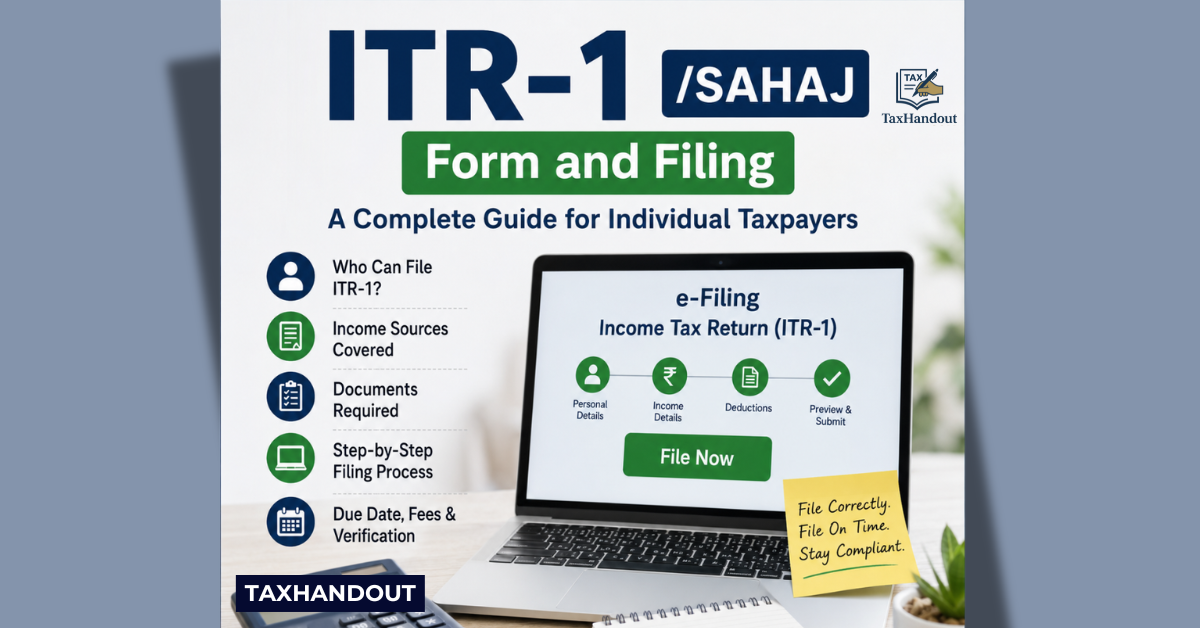
ITR-1, also known as Sahaj, is one of the simplest Income Tax Return forms for individual taxpayers in India. It is mainly used by salaried individuals, pensioners, and small taxpayers having income from limited sources.
What is ITR-1 / Sahaj?
ITR-1 is an Income Tax Return form used by eligible resident individuals to report their income, deductions, taxes paid, and refund or tax payable details to the Income Tax Department.
It is called “Sahaj” because it is designed to be simple and easy for common taxpayers.
Who is Eligible to File ITR-1?
ITR-1 can generally be filed by a resident individual having total income up to ₹50 lakh from the following sources:
- Salary or pension income
- Income from one house property
- Income from other sources such as interest, family pension, dividend, etc.
- Agricultural income up to ₹5,000
- Long-term capital gain under section 112A up to the permitted limit, subject to conditions
Example:
Mr. A is a salaried employee earning ₹9 lakh per year. He has bank interest of ₹15,000 and owns one self-occupied house. He can generally file ITR-1.
Who Cannot File ITR-1?
You cannot file ITR-1 if:
- You are a Non-Resident or RNOR
- Your total income exceeds ₹50 lakh
- You have income from business or profession
- You have capital gains not allowed in ITR-1
- You own more than one house property
- You are a director in a company
- You hold unlisted equity shares
- You have foreign assets or foreign income
- You have agricultural income above ₹5,000
- You have income from virtual digital assets such as crypto
- You need to claim foreign tax relief
For such cases, ITR-2, ITR-3 or ITR-4 may be applicable depending on the facts.
Income Sources Covered Under ITR-1
ITR-1 covers limited and simple income sources:
| Income Source | Covered in ITR-1? |
| Salary | Yes |
| Pension | Yes |
| One house property | Yes |
| Bank interest | Yes |
| Family pension | Yes |
| Dividend income | Yes |
| Agricultural income up to ₹5,000 | Yes |
| Business income | No |
| Professional income | No |
| Multiple house properties | No |
| Foreign income | No |
Documents Required Before Filing ITR-1
Keep these documents ready:
- PAN and Aadhaar
- Form 16 from employer
- Form 26AS
- AIS and TIS
- Bank statements
- Interest certificates
- Rent receipts, if claiming HRA
- Home loan interest certificate
- Proof of deductions under sections 80C, 80D, 80G, etc.
- Details of all bank accounts
- Capital gain statement, if applicable under permitted category
Important: Do not blindly rely on Form 16. Always match Form 16 with AIS, TIS and Form 26AS.
Due Date, Late Fees and Verification
For most individual taxpayers not liable for tax audit, the usual due date is 31st July of the assessment year, unless extended by the Government.
If the return is filed late, late fee under section 234F may apply:
| Total Income | Late Fee |
| Up to ₹5 lakh | Up to ₹1,000 |
| Above ₹5 lakh | Up to ₹5,000 |
Interest under sections 234A, 234B and 234C may also apply if tax is payable.
Verification can be done through:
- Aadhaar OTP
- Net banking
- Bank account EVC
- Demat account EVC
- Sending signed ITR-V to CPC Bengaluru
FAQs on ITR-1 Filing
1. Can a salaried person file ITR-1?
Yes, if the person is a resident individual and satisfies the eligibility conditions.
2. Can I file ITR-1 if I have two employers?
Yes, provided your income sources are otherwise eligible. You must report salary from both employers.
3. Can I file ITR-1 if I have business income?
No. Business or professional income is not covered in ITR-1.
4. Is Form 16 enough for filing ITR?
No. You should also check AIS, TIS, Form 26AS and bank statements.
5. Can I file ITR-1 if I have one house property?
Yes. Single or joint ownership of one house property may be allowed, but income from more than one house property is not allowed in ITR-1.
6. What happens if I do not e-verify ITR?
If ITR is not verified within the prescribed time, it may be treated as invalid.
7. Should I consult a tax professional?
Yes, if you have capital gains, foreign income, business income, multiple properties, AIS mismatch, high-value transactions, or notices from the department.
ITR-1 is a simple and useful return form for salaried individuals, pensioners and small taxpayers. However, “simple” does not mean “casual”. You must select the correct form, verify AIS and Form 26AS, report all income, claim only genuine deductions and complete e-verification on time.
File your ITR correctly and before the due date. If your case is complex, consult a qualified tax professional instead of taking unnecessary risk.