
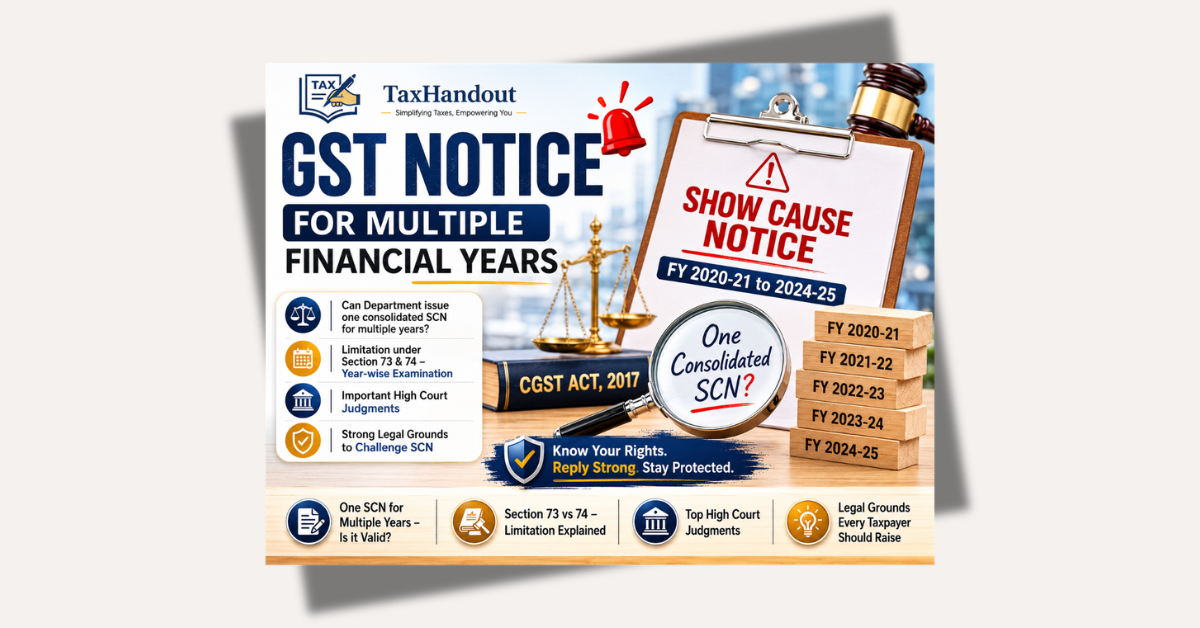
In recent months, many taxpayers have started receiving GST audit notices and show cause notices covering multiple previous financial years, such as FY 2020-21 to FY 2024-25.
This has created a serious concern in trade and industry because one consolidated GST notice may cover different tax periods, different facts, different limitation dates and different legal positions.
The key question is:
Can the GST department issue one single show cause notice for multiple financial years?
The answer is not completely simple. Several High Courts have held that clubbing multiple financial years in one GST SCN is not legally sustainable. However, there are also contrary developments, especially in Karnataka. Therefore, taxpayers should take this ground carefully, with proper legal drafting and jurisdiction-wise case law support.
What Is a GST Show Cause Notice?
A Show Cause Notice, commonly called SCN, is a formal notice issued by the GST department asking the taxpayer to explain why tax, interest or penalty should not be demanded.
SCN may be issued for:
- Short payment of tax
- Non-payment of tax
- Wrong availment of ITC
- Wrong utilisation of ITC
- Excess refund
- Suppression of outward supply
- Mismatch in returns
- Audit objections
Generally, GST demand notices are issued under:
- Section 73 – cases other than fraud or suppression
- Section 74 – cases involving fraud, wilful misstatement or suppression of facts
Why Multiple-Year GST Notices Are Problematic
A consolidated GST notice covering multiple financial years creates practical and legal problems.
Each financial year has:
- Separate annual return due date
- Separate limitation period
- Separate books of accounts
- Separate reconciliations
- Separate GSTR-1, GSTR-3B and GSTR-9 data
- Separate factual defence
- Separate ITC eligibility position
Therefore, if the department issues one common SCN for several years, the taxpayer may argue that the notice is vague, defective and contrary to the scheme of GST law.
Limitation Under Section 73 and Section 74
Limitation is one of the strongest grounds in GST litigation.
Under Section 73, the order must generally be passed within the prescribed time from the due date of annual return for the relevant financial year.
Under Section 74, where fraud, suppression or wilful misstatement is alleged, a longer limitation period applies.
But the important point is:
Limitation has to be examined year-wise.
For example, the limitation for FY 2020-21 cannot be mechanically clubbed with FY 2023-24. Each year has its own annual return due date and its own limitation calculation.
Can Department Use Section 74 to Save Time-Barred Demand?
This is a common departmental approach.
Where the normal limitation under Section 73 is expired, the department may try to invoke Section 74 by alleging suppression or wilful misstatement.
However, Section 74 cannot be invoked casually.
The notice must clearly show:
- What fact was suppressed
- How it was suppressed
- Whether suppression was intentional
- Whether there was fraud or wilful misstatement
- Why the case falls under Section 74 and not Section 73
A mere difference in return data, ITC mismatch or audit objection does not automatically become suppression.
Important Judgments on Consolidated GST SCN
1. ICAD School of Learning Pvt. Ltd. vs Union of India
The Bombay High Court held that there is no scope for consolidating various financial years or tax periods while issuing a show cause notice under Section 74 of the CGST Act. The Court observed that GST law works on a year-wise structure and limitation must be examined separately for each year.
2. Hakikatrai and Sons vs Union of India
In this case, the Bombay High Court considered a notice issued under Section 74 covering FY 2018-19 to FY 2022-23. The Court held that clubbing multiple financial years in a single SCN under Section 74 is not permissible and the notice was set aside.
3. Veremax Technologie Services Ltd. vs Assistant Commissioner
Earlier, the Karnataka High Court Single Judge had held that the department cannot issue a common SCN by grouping multiple tax periods together. However, later reports indicate that the Division Bench allowed Revenue’s appeal and held that there is no statutory bar on common SCNs covering multiple years. Therefore, this case should be used with caution and the latest status must be verified before relying on it.
Practical Grounds to Take in Reply to GST Notice
If a taxpayer receives one consolidated GST SCN for multiple years, the reply should not be limited only to factual reconciliation. Legal grounds must also be raised.
Important grounds may include:
- The SCN is consolidated and vague.
- Year-wise demand has not been properly determined.
- Limitation differs for each financial year.
- Section 73 limitation may have expired for earlier years.
- Section 74 cannot be invoked without specific allegation of fraud, suppression or wilful misstatement.
- The notice violates principles of natural justice.
- The taxpayer is unable to file an effective year-wise defence.
- Separate financial years require separate examination of facts and law.
Draft Legal Ground for Reply
The taxpayer may include a ground like this:
“Without prejudice to the merits, the impugned show cause notice is legally defective as it seeks to club multiple financial years in one consolidated proceeding. Each financial year has separate statutory returns, separate annual return due dates, separate limitation periods and separate factual matrix. Therefore, the demand, if any, ought to have been determined year-wise. The consolidated notice causes serious prejudice to the taxpayer and is contrary to the statutory scheme of Sections 73/74 of the CGST Act.”
Important Caution for Taxpayers
Taxpayers should not assume that every consolidated notice will automatically be quashed.
The legal position is still developing. Different High Courts may take different views. Also, if the notice contains proper year-wise breakup, clear allegations and separate limitation analysis, the department may defend it strongly.
Therefore, the reply must be drafted after checking:
- Jurisdictional High Court position
- Section invoked: 73 or 74
- Period covered
- Date of SCN
- Date of annual return
- Whether fraud/suppression is specifically alleged
- Whether year-wise demand is given
- Whether proper documents are attached
A GST notice covering multiple previous years is not just a routine compliance issue. It may involve serious legal defects, especially where the department has issued one consolidated SCN without year-wise determination of demand and limitation.
The taxpayer should carefully examine whether the notice is legally valid, whether limitation has expired for any year, and whether Section 74 has been invoked without proper basis.
A strong GST notice reply should contain both:
- Factual reconciliation; and
- Legal objections.
In many cases, the legal ground of consolidated SCN for multiple years can become a strong defence for the taxpayer. However, it must be used carefully with updated case laws and jurisdiction-specific legal support.
Need consultation in gst