In recent time, many taxpayers have received GST notices under Section 74 of the CGST Act, especially for old financial years where the limitation period under Section 73 is either close to expiry or has already expired.
This has created a common concern:
“Kya Department har tax demand ko Section 74 ka case bana sakta hai?”
The legal answer is:
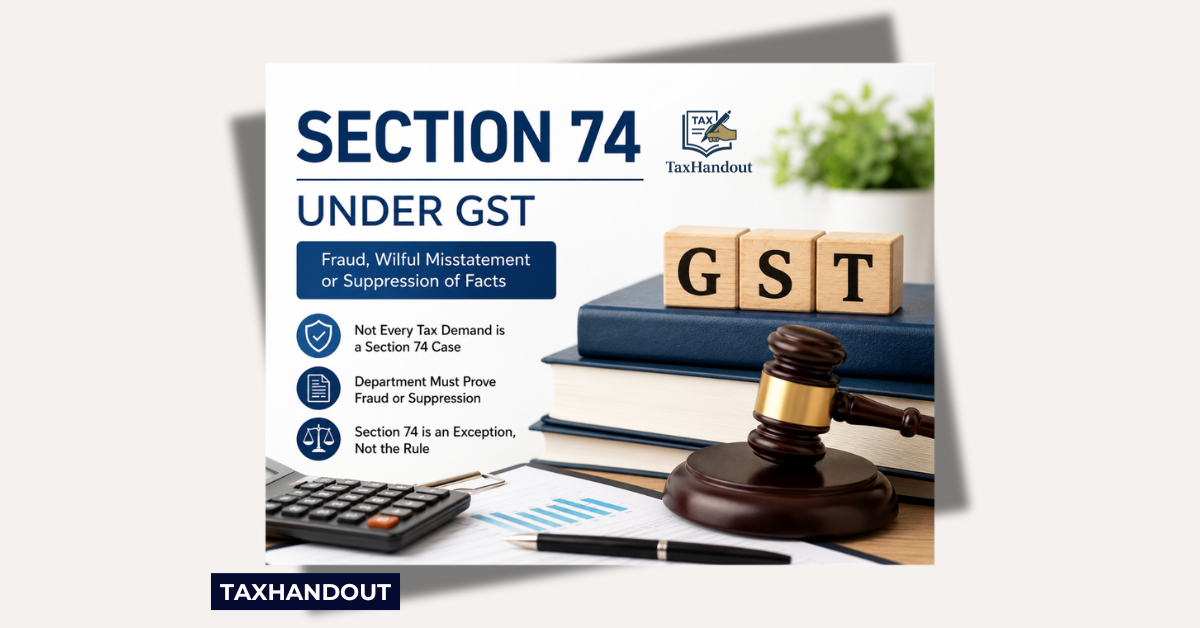
No. Every tax demand does not automatically become a Section 74 case.
The GST law clearly differentiates between ordinary tax disputes and cases involving fraud or deliberate tax evasion.
Let us understand the legal position in detail.
What Is Section 74 of the CGST Act?
Section 74 applies where:
- Tax has not been paid,
- Tax has been short paid,
- Refund has been wrongly obtained, or
- Input Tax Credit (ITC) has been wrongly availed or utilised,
by reason of:
- Fraud,
- Wilful misstatement, or
- Suppression of facts to evade tax.
Thus, Section 74 is a special provision intended for serious cases involving an intention to evade tax.
Difference Between Section 73 and Section 74
| Particulars | Section 73 | Section 74 |
| Nature of default | Non-fraud cases | Fraud/suppression cases |
| Requirement of intent | Not required | Required |
| Fraud allegation | No | Yes |
| Wilful misstatement | No | Yes |
| Suppression to evade tax | No | Yes |
| Penalty exposure | Lower | Higher |
| Limitation period | Normal period | Extended period |
The most important distinction is the presence of mens rea (intention to evade tax).
What Must the Department Prove?
For a valid Section 74 proceeding, the department should be able to demonstrate:
1. Fraud
There must be material indicating deliberate deception to evade tax.
2. Wilful Misstatement
The statement must be knowingly false and made intentionally.
A genuine mistake or interpretational issue generally cannot be treated as a wilful misstatement.
3. Suppression of Facts
There should be deliberate withholding of information that the taxpayer was legally required to disclose.
Mere omission or clerical error is not automatically suppression.
The courts have repeatedly observed that suppression must have a nexus with tax evasion and cannot be presumed merely because tax is demanded.
Practical Examples Where Section 74 May Not Sustain
Example 1: ITC Eligibility Dispute
A taxpayer claims ITC based on a legal interpretation.
Later, the department adopts a different interpretation.
This is generally a legal dispute and not necessarily a fraud case.
Example 2: Difference Between Books and Returns
Turnover appears differently in books and GST returns due to classification or timing differences.
If all records were disclosed and available to the department, alleging suppression becomes difficult.
Example 3: Bona Fide Accounting Error
A genuine accounting mistake results in short payment of tax.
Unless evidence shows deliberate concealment, Section 74 may not be justified.
CBIC’s Own Clarification on Section 74
A significant CBIC Instruction No. 05/2023-GST issued on 13 December 2023 clarified that Section 74 cannot be invoked merely because GST has not been paid.
The instruction specifically states that there should be material evidence of fraud, wilful misstatement, or suppression of facts to evade tax, and such evidence should form part of the show cause notice.
This clarification has become an important defence for taxpayers facing mechanically issued Section 74 notices.
Important Judicial View
Courts have repeatedly observed that:
- Every non-payment of tax is not tax evasion.
- Every tax difference is not suppression.
- Mere allegations are insufficient.
- Fraud and suppression cannot be presumed.
- The burden lies on the department to establish the conditions required under Section 74.
Several recent decisions have reiterated that proceedings under Section 74 cannot survive where the department fails to demonstrate fraud, wilful misstatement, or suppression with intent to evade tax.
Key Questions Taxpayers Should Ask After Receiving a Section 74 Notice
Before replying to any Section 74 notice, examine:
- Has the notice specifically alleged fraud?
- What evidence has been relied upon?
- Is there any allegation of wilful misstatement?
- Were all transactions already disclosed in returns or books?
- Is the dispute merely interpretational?
- Has the department only used general language without supporting facts?
These questions often become crucial in litigation.
Penalty Under Section 73 vs Section 74
One of the major consequences of classification under Section 74 is the significantly higher penalty exposure.
| Particulars | Section 73 (Non-Fraud Cases) | Section 74 (Fraud/Suppression Cases) |
| Nature of Case | Tax short paid without fraud, wilful misstatement or suppression | Tax short paid due to fraud, wilful misstatement or suppression |
| Before SCN | No penalty if tax and interest are paid before issuance of SCN | Penalty of 15% of tax payable along with tax and interest |
| Within 30 days of SCN | No penalty if tax and interest are paid within 30 days of SCN | Penalty reduced to 25% of tax |
| After Order but within 30 days | Penalty of 10% of tax or ₹10,000 whichever is higher | Penalty reduced to 50% of tax |
| Beyond 30 days of Order | Penalty of 10% of tax or ₹10,000 whichever is higher | Penalty equal to 100% of tax |
Practical Impact
Suppose the GST demand is ₹10 lakh:
| Stage of Payment | Section 73 | Section 74 |
| Before SCN | Nil Penalty | ₹1.50 lakh (15%) |
| Within 30 days of SCN | Nil Penalty | ₹2.50 lakh (25%) |
| Within 30 days of Order | ₹1 lakh (10%) | ₹5 lakh (50%) |
| After 30 days of Order | ₹1 lakh (10%) | ₹10 lakh (100%) |
This itself explains why taxpayers frequently challenge the invocation of Section 74. Once Section 74 is sustained, the penalty exposure can become extremely substantial compared to a normal Section 73 proceeding.
Section 74 is one of the most stringent demand provisions under GST law.
However, it is not meant to be applied mechanically in every tax dispute.
The department may issue a notice under Section 74, but for the demand to legally survive, it must establish fraud, wilful misstatement, or suppression of facts with intent to evade tax.
Therefore, taxpayers should not assume that merely because a notice mentions Section 74, the allegation automatically stands proved.